In searching for a definition for a horse world phrase that’s always puzzled me — “an ‘own son’ of [famous sire]” — I came across a thread in which people expressed their abhorrence of various practices used in all kinds of competitions. Horrific, evil things I don’t even want to list here, that are apparently considered normal ways to get your horse to look, move, and behave in certain ways in a number of disciplines.
I am so glad I got my first horse in my late 30s and have never had much contact with the show world.
I am so glad I found what one of the posts referred to as “all that Parelli nonsense,” with its focus on partnership and humane treatment.
I am so glad I am part of the Parelli student body at a time when the Celebrations, the Games (as in competitions, not as in the language of the seven games), the support for play groups, and other avenues for cooperation and for competition are becoming more available to more of us. I would love to take Rocky places to show off his brilliance and beauty. But I don’t ever want to go to a normal show again — the three I’ve seen, ranging from a schooling show to the National Gran Prix jumping at the Los Angeles Equestrian Center, combined with what I have gleaned from reading, make it clear that it’s not a place for me.
Obviously not everyone outside of Parelli mistreats horses, and some people who have natural partnerships with their horses can’t stand Parelli, and there are people competing at all levels in all disciplines who do not practice cruelty.
I do hope that anyone who starts to question why they are doing what they’re doing will Google it and find better ways to treat their horses. “Everyone does it” is an excuse no teenager gets away with, so why should adults, when doing things to horses that anyone with an ounce of empathy knows is horrible? “You have to do it to win” is the same justification athletes use about steroids, models use about starvation, pimps use about beating up sex workers, and politicians use about mudslinging.
Displaying ribbons and trophies won through abusive practices is eerily similar to serial killers and stalkers keeping photographs, articles, videos, and even more grisly mementos of their own obsessions.
Displaying ribbons and trophies won through putting the relationship first, working together toward a goal, preserving the dignity of the horse, and striving for continual improvement with a horse who loves his job and performance? Beautiful! What a cool tribute to the time, effort, and give-it-your-all spirit!
How anyone who thinks they loves horses could perpetuate these tortures in these times when so many natural horsemanship practitioners are online and on television and authoring books and trying so hard to make a living by getting the word out is beyond me. How anyone who does NOT love horses can be or stay in the horse world when it is so expensive and so risky is equally hard to fathom.
But I think every time I start to feel like I’m failing Rocky with my lack of savvy, progress, time, or confidence, I will remind myself of what so many horses suffer, and that Rocky will never experience the cruelty, injustice, or pain-inflicting practices that so many horses do. He’s in his forever home with a human who keeps trying to do better and better to provide him with purpose, play, and partnership. He’s fine.
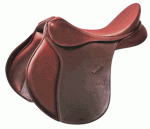 We used my English saddle this time as Rocky’s back was a little sore from Tuesday, but I took the stirrup leathers off and left them in the tack room. It was much harder to stay on my balance point at first, as the high cantle wants to tip my pelvis the wrong way — with a hollow lower back rather than a rounded one. Once I got the gist of where to sit, though, I was able to adapt. My saddle is the Bates Caprilli all-purpose model with the changeable gullets and I had it computer-fitted to Rocky so I know it fits him well (or at least, it did last year).
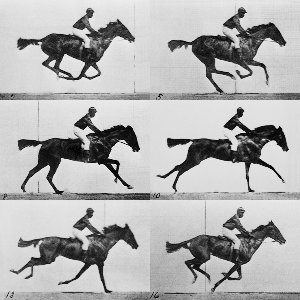 But I’m riding as a passenger now, sans stirrups, imagining a ball joint behind my belly button and bearings in my hips. I also tried what Linda calls “pedaling,” moving my whole leg from the hip, not just the ankle, following her maxim that it’s harder to tense up and brace if you’re moving. I didn’t have to do that very long before I could keep the joint loose without exaggerating the motion — yay! — and yet doing it really helped me feel when Rocky’s hind legs are in the air and swinging forward. I told Erin that I had a glimmer of what Bill Dorrance writes about, knowing where the horse’s feet are. (Discovery has an interesting blog post about


 Horsegirl on a Journey