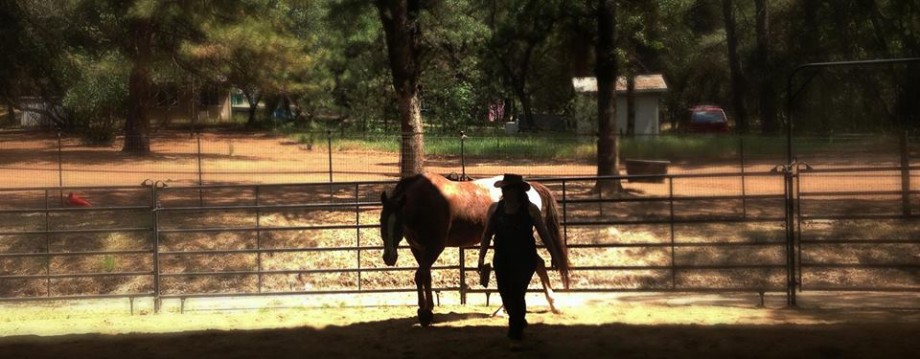
Riley and Star were away on a trail ride again, leaving Rocky alone in the Back 40. This time when I went out there he whinnied and ran to meet me at the gate and was all nuzzling in for reassurance, then lifting head up, then nuzzling down again. Last time he was left behind, he stood at his hay pile pretending to eat but with his body tense and ears rigid, looking at me with both eyes but not coming over until I got within six feet, when he took a step toward me and extended his muzzle.
 I let him in the arena to roll and then he galloped around bucking and kicking and neighing. As soon as he stopped making circuits and started pacing the front side, I slipped in and encouraged him to move, by wiggling the 45-foot line I held coiled in my hand. When he’d come to the corner and turn, I’d encourage the change of direction then go back to neutral as soon as he moved off. I did this several times, working on shifting my own energy from intense to neutral (and realizing again, even more clearly, that I need a lot of work on intensity, though my neutral is adequate).
He started making full circuits of the arena and I stayed in neutral except for those times he stopped in right-brain pose, head up and tense tail, at which point I pointed in the opposite direction he’d been traveling and slapped the coiled rope against my other thigh to tell zone 4 to move. He’d take off again. And then … he stopped and lowered his head and gave me two eyes and blew out through his nose. I smiled, took a step backward, and he trotted to me in a straight line except for veering off to put my on his left at the very last moment. I petted and talked to him and waited for the lick and chew, but he flung his head up and got tense again, so I sent him off.
The next time he asked to come in, I switched my rope from side to side, but had the vision in my mind that I was using the carrot stick for S-patterns. It worked and he corrected course each time and this time stood for a while and licked and chewed. I said come with me to get a cookie and he struck to me all the way to the mailbox in the corner where we keep the treats.
That was my strategy today:
When you’re anxious (RB), you’re gonna move. Even when he stands still, it’s not in an RBI pose, it’s in an “I’m just sending adrenalin to my muscles to pump them up, a la Lee Child’s Jack Reacher, before I sprint off again” readiness. In fact, it’s past Ready and well into Get Set. Moving him at this stage is a recent “what I’m doing isn’t working, I’m going to try something else.” Before I would try some RBI strategies of “be gentle with me” because I mistook his standing in place as stillness and retreating within. But having seen him go from LBE to LBI in a 3-second sucking in when I put him on-line, I thought maybe he is still being RBE, just not having to move his feet right at that second.
When you’re calm (LB), you can relax with me, and if you start to look around for something to do other than hang out, I’ll give you something active to do, like send you out and then run backwards and draw you to me. It was all at liberty and he added a Touch-It to his draw, coming in mostly straight, correcting without fear when I lightly wiggled my coils, and then touching the rope with his nose when he arrived.
It worked. Especially the treating him like RBE instead of RBI the whole time he was RB. And keeping my energy and perspective happy and positive and not being scared at his power as he ran around all loco, but supporting his ideas of motion and adding a bit more, and welcoming him in when he wanted to come in.
Then I overdid it.
When he was calm and tuned in to me, I put some cones out and put on his halter, to do a figure 8 with the longer rope. It was a disaster. He was less willing and I overdid the energy when I used the vertical swing on the rope to stop forward motion when he was going to pass the cone on the inside. I pushed him too hard and took the fun out of the pattern, and in fact he didn’t even act like he remembered how to do a figure 8, and did not offer anything: not impulsion, not bend, not “oh hey I know what those cones are for.”
I gave up on the figure 8 and tried for a few circles just to get more familiar with the feel of the new rope, and using lots of draw and send; I welcomed him in every time he came in and then sent him again right away, and that helped us reconnect. I took him to the mailbox for another cookie and then led him home to the back 40, taking him to a hay pile and feeding him some while I exchanged the halter for the fly mask.
I looked up “scared RBI” in the Savvy Club Q&A vault to verify how to word the “be gentle with me” strategy, and found an answer that I need to ponder. Thinking of the innate horsenality as the main leadership strategy and adding bits from the other quadrants to address specific behaviors but not totally replacing main strategy … Maybe this is a way to think about it, to help me get better in my responses, now that I can read him so much better.
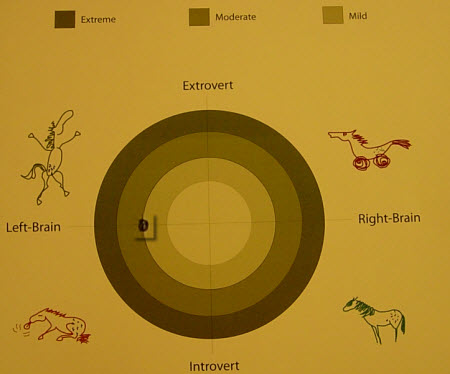
It is very important to know your horse’s Horsenality innately. When horses show characteristics of another quadrant, it doesn’t mean that they should be categorized as THAT quadrant. For example, if a horse is innately a RBE and has moments of confidence where they get pushy and dominant with zone 1 (characteristics of LBI) if you were to use strategies for a LBI and treat them like a LBI, you would blow their confidence in you out of the water. This would be completely ineffective. What you are seeing when an innately RBE horse gets more confident and pushy is that they have become more CENTERED within the concentric circles of mild, moderate, extreme on the Horsenality chart. Centered just means they are more calm(RBE), trusting(RBI),obedient(LBE) or motivated(LBI) and showing characteristics shared by the other three quadrants. So this is where the wheels in your mind start turning…right? What is my horse innately, and what is the filter of that horsenality as a leadership strategy.



 Horsegirl on a Journey