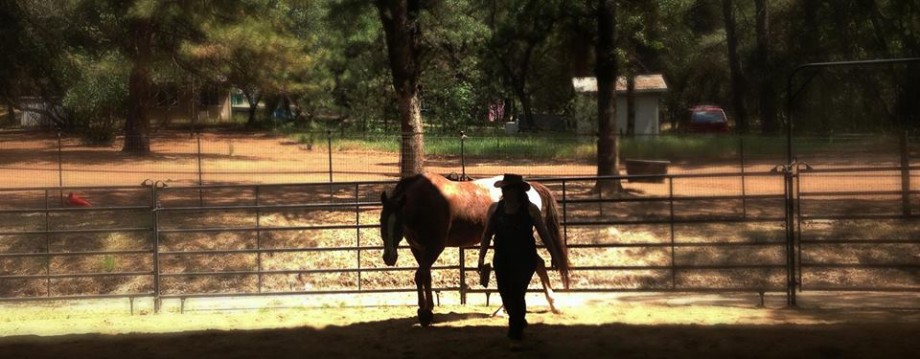
I understand that exuberance can be a little scary at first. — Erin Murphy, Equine Partners, Inc.
Rocky started out at liberty by racing around the arena, bucking and snaking his neck, totally disrespectful of anything mere humans might want. Obviously he’s no longer too footsore to play, and it was great to see him buck and leap and twist and kick out and really arch his neck and show off his huge trot.
Then when he rolled he got all the way up on his spine, although he didn’t roll all the way over. Given how much better his health has been since we moved here, I’m hopefully he’ll be able to make it all the way over someday. He didn’t used to be able to get up onto his spine.
I tried some “extreme” catching game to get him to tune in, and when he came to me, I waited for him to put his nose into his halter rather than just put it on him. See? I can be taught. Of course, I had to tell him aloud “please consent to your bondage,” because that’s the kind of partner I am, but I did wait politely for him to do so. Then Erin and I watched as my LBE transmogrified into an LBI. Later, when she worked with him to teach him S-turns to improve his draw, he went RBE until Erin’s consistency brought him back to himself and he started solving the puzzle. And briefly, he had a moment of planting all four feet, head way up, eyes wide, but now I can’t remember why.
The S-turns were scary to watch at first. What you do is put your carrot stick in the hand you’re most facile with (my right) and hold the line in the other hand. You set the horse up to face you and then you run backward, keeping tension on the line. Any time the horse is not facing you straight on, you change direction so you are going in the opposite direction as the horse — heading back past their hind end. At the same time, you block their turn with the stick and string. It’s an energetic swing that whistles through the air and slaps the ground in zone 2/3/4, and it’s possible that a horse will run into it, although Rocky did his best to reverse direction fast. Erin described it as flicking the string out like it’s your hand and you are scooping the horse into you by reaching out to zone 3/4 and drawing toward you. If they go to the right, you flick on the right. “Don’t go that way!” If they go to the left, you flick on the left. “Don’t go that way!” All the while keeping tension on the line … until the horse puts slack in it.
The lesson is twofold. The horse has to figure out that if he trots right at you, nicely straight and centered and with slack in the line, you stop changing direction and flicking the stick and indeed you slow to a stop and give him time to rest. If he’s LBI, you give him a cookie. The horse also has to figure out that it is his responsibility — not yours — to keep slack in the line. When he keeps the slack, the pressure goes away. No stick, no string, no sudden changes of direction.
The 180-degree turns are the same thing you do when teaching a Labrador not to pull on the leash– when the dog hits the end of the leash you turn and walk briskly the other way, until he learns to keep slack — but doing that while also getting a good string swing while also running backwards while also seeing the full 1100 pounds of horse wheeling side to side to try to figure out this new game … it’s a workout for sure.
Erin did it with Rocky for a while to teach him the game, after I struggled with figuring it out. He kept thinking the swing of stick and string meant circle, so he’d try to scoot off but would get blocked. That’s when he started rearing up a little and that was scary to watch. But then I realized he wasn’t rearing or striking, he was just changing direction so fast that he was sitting back on his hindquarters to pivot his front end around. My nervousness changed to pride: what an athletic boy I have! I also saw how careful he was not to run over or step on Erin when he figured out to trot in to her. She played with him long enough that he had several successes in a row and then handed him back to me — having given both Rocky and I time to work through the “whu? huh?” stage and get some confidence.
I had a hard time coordinating my turns with bringing my stick under the line and flicking it out to the left, and my backward run was more of a jog, but since Rocky had figured out the puzzle by then, we were able to get some practice in.
Our homework is to play all seven games online with the belly of the rope on the ground to prepare us for liberty, and to practice these S-turns for at least two more sessions to improve our draw and earn his respect.


 Horsegirl on a Journey