Author Archives: horsegirlonajourney

Learning to float with the movement of the horse

I have in the past year learned to see the physical stuff with horses, the issues with balance and coordination and fitness and general wellness that lifelong horse professionals probably can’t believe isn’t obvious to all of us. But now that I can see it, now that I can evaluate my horses’ soundness and comfort on any given day, I have become fascinated by horse anatomy and how it all fits together.

The Horses Inside Out DVD has been a wonderful resource. So has Zen and Horseback Riding.

Riding Art offers some of the most effective illustrations I’ve seen for showing how horses balance, with and without riders.

horse balance

horse out of balance

In order for a horse to carry itself gracefully and most efficiently, it must be permitted to carry itself in a posture that allows for balance to improve. The rider must tactfully help the horse find the posture where the haunches are best able to help lift and carry the mass of the rider and the forehand. ~ Tonja Dausend, Riding Art

In Parelli, we learn about doing in our bodies what we want our horses to do in theirs. We engage our core, round our lower back, ride from our seat instead of our stirrups or our reins.

We practice “passenger lessons,” where we ask the horse to go forward and then we mirror their movements in our bodies without attempting to steer or lead them. If we don’t feel safe doing this, we find an instructor or a friend to play with our horse on-line with us as passengers. When you ride passenger without tension in your body, looking left when the horse looks left, bending your ribcage right when the horse bends right, you find that when you do in your body what your horse is doing in his, there is harmony between you. It is easier for the horse to carry you and easier for you to be carried.

When you ride a horse, balance comes, not from freezing your legs to the saddle, but from learning to float with the movement of the horse as you ride. Each step is a dance, the rider’s dance as well as the dance of the horse. ~ Chogyam Trungpa Rinpoche, “Shambala: The Sacred Path of the Warrior”

What has been cool for me is that I’ve always done pretty well with balance exercises, even after I lost fitness and found extra weight. My weekly session with Gabriel’s Yoga Therapy includes some intense balance practice, including several balance-related asanas and interesting walking-on-my-toes-with-my-eyes-shut-and-arms-extended-in-front-of-me exercises. Now that I am not tense with fear or vibrating with anxiety every time I mount a horse, I’m having more success in translating my good balance from ground to riding.

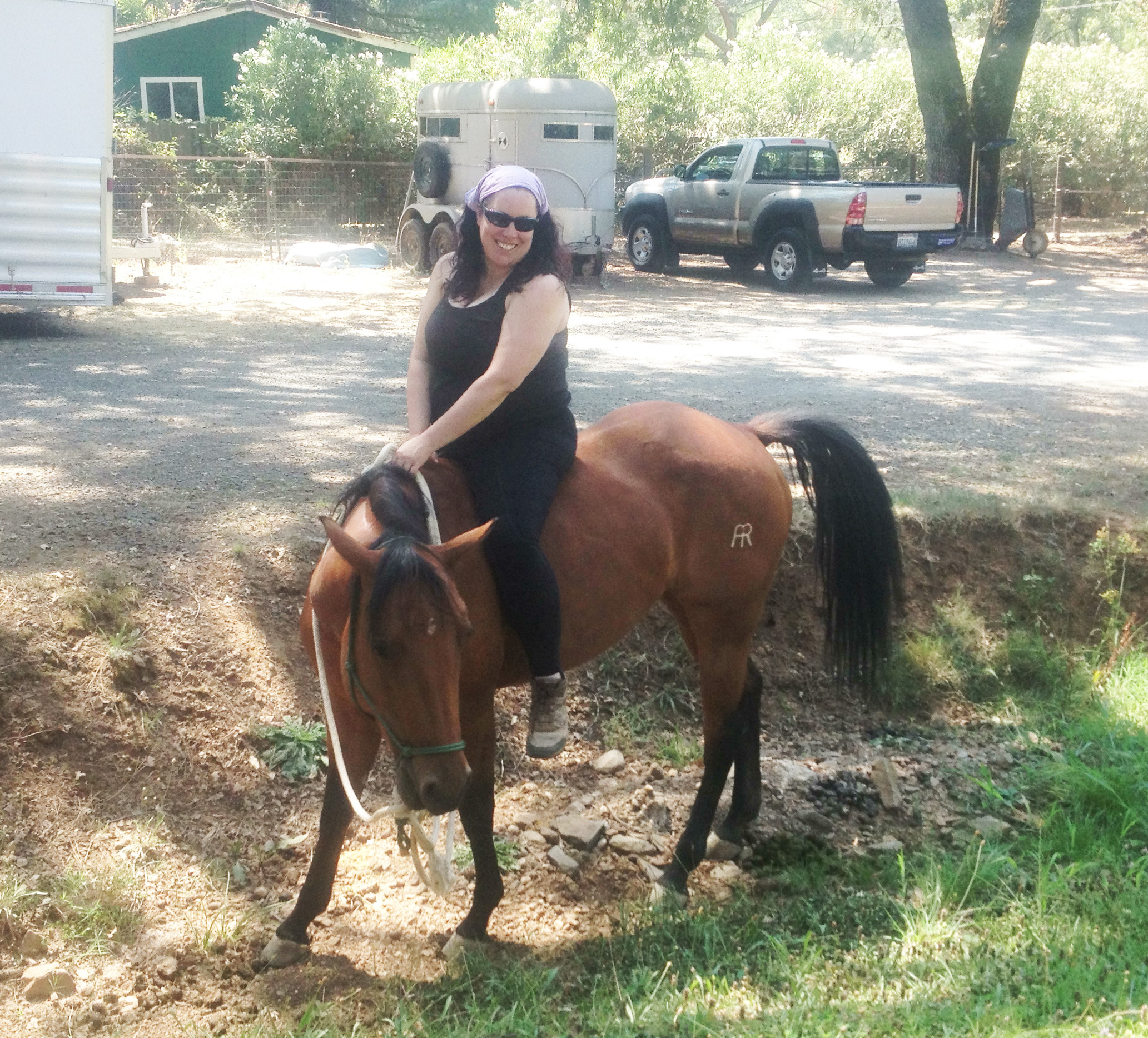
I have been hopping on River bareback when it’s time to go back to her pen, focusing on the gate, and thinking strongly of cookies. She has been willing and relaxed about this. Most recently, I rode her from further away from her pen than I had before, putting her in the creek bed so I could slither on from the bank. We rested in the (dry) creek for a while and I looked where she looked. I felt totally balanced and secure.
river_creek01


Looking at her ears instead of where she’s looking put some unnecessary tension into my body, and my left foreleg is in front when to mirror her my right foreleg should be forward. (I believe I was organizing the hackamore’s lead rope so that it didn’t fall under her feet, but still!)

river_creek03

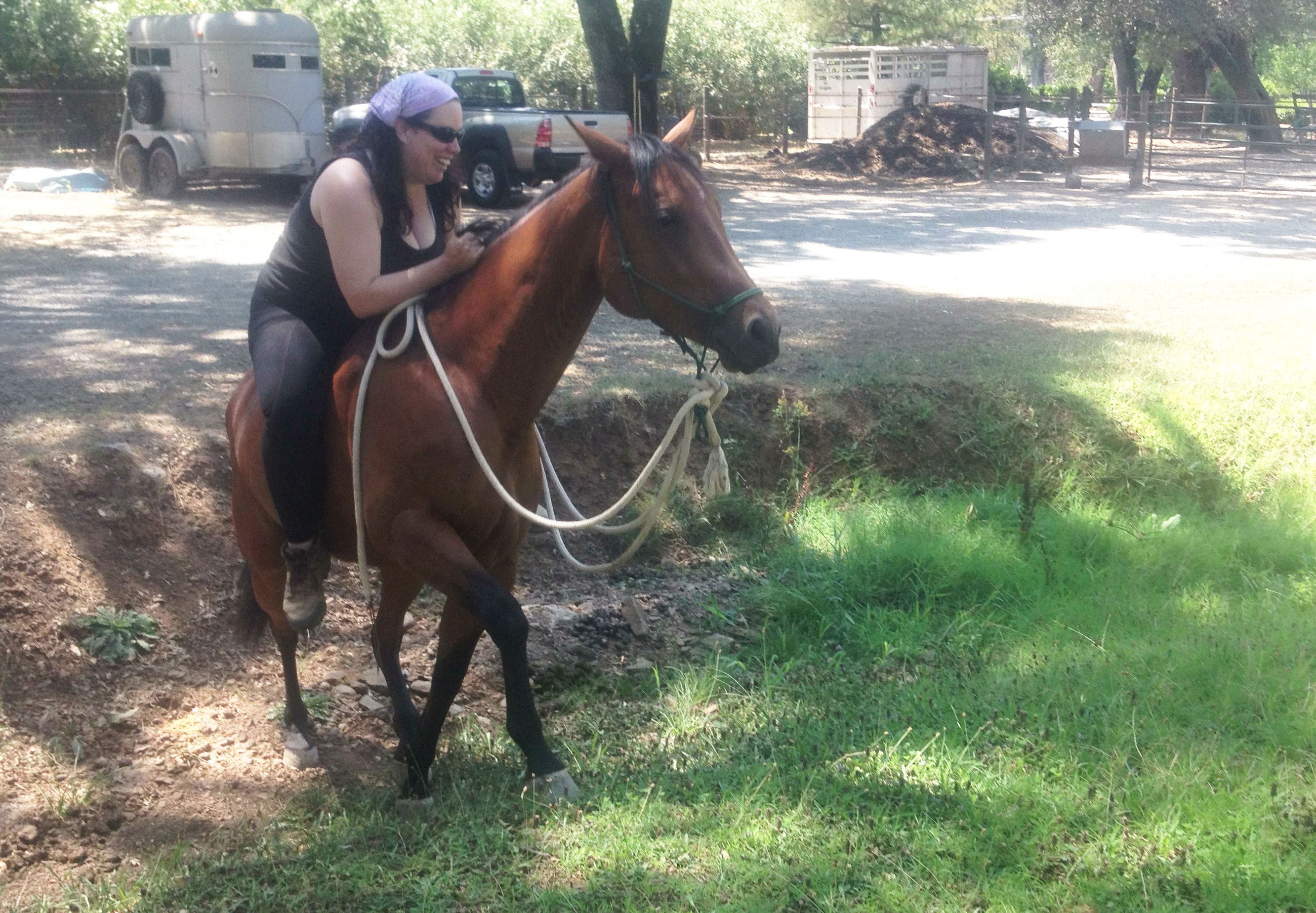
We then climbed right up the side to graze on the lawn for a bit before heading back. The photos don’t show the steepness of the bank, but you can see from my body position (and if you look closely at the angle of her stifle and hocks) how deep and steep it was — maybe about a four-foot step, at that place. I’m holding on gently with my thighs and have a firm grip on her mane, but my lower legs are just touching her, not squeezing or digging my heels in. I visualized stepping my hind legs under me to push me up the slope.
river_creek02

Once we were level again, I sat up slowly and smoothly rather than jerk my torso upright. This is part of my focus on fluidity, realizing that I never have to hurry, that intensity doesn’t mean speed. Taking the time to get fluid first and then add in the speed later. And I looked where River was looking.

river_creek04


Categories: Freestyle, Health | Tags: , , | Leave a comment

Detailed horsemanship: building a better send

Erin interrupted herself in my lesson today, apologizing half-seriously. “I’m picking apart your send. I’m so picky! Picky picky picky!” I laughed and told her that’s what we hire her for, that I appreciate her attention to detail. “I’m picky with you because I know you can take it,” Erin said then.

Take it? I crave it. Erin excels at separating each step of a process, isolating and fixing the techniques that are causing problems, and recombining the steps into a process that works.

Lesson Flower

Today, the circle game at liberty proved powerful. River became not so much a mirror as a microscope. The cause of the problems was my send, and the solution was threefold.

1. Refine my phases

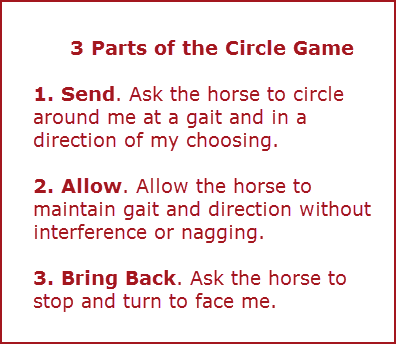
3 parts of the circle gameIn Parelli level 2, we learn to give the horse a long phase one and then if necessary a quick two-three-FOUR. We also learn about tagging the ground, not the horse, so that the horse has time to move forward and “win” the game by not getting tagged.

What I have ingrained in my body motion is to go up two-threeFOUR! with FOUR! being a loud, strong whzzzzzzWHAPP on the circle at 12 o’clock. Typically, River moves off of 12 o’clock just in time, slowly but impudently, and swishes her tail to show her disdain.

What Erin sees happening is that I am dulling River to the whzzzzzzWHAPP. And that it looks like I am threatening her, when I raise the stick and string and focus so intently on the spot and then “attack” it so hard. At the same time, I leave myself nowhere to go if I need to escalate, and I have convinced River that I’m usually not going to touch her so she doesn’t really have to get a move on.

Erin helped me refine my phases to be effective without threatening.

  1. Point.
  2. Add voice cue.
  3. Lift stick.
  4. Wiggle stick.
  5. Flick horse with string. A flick with intensity, but not a big loud fast overhead whzzzzzzWHAPP.

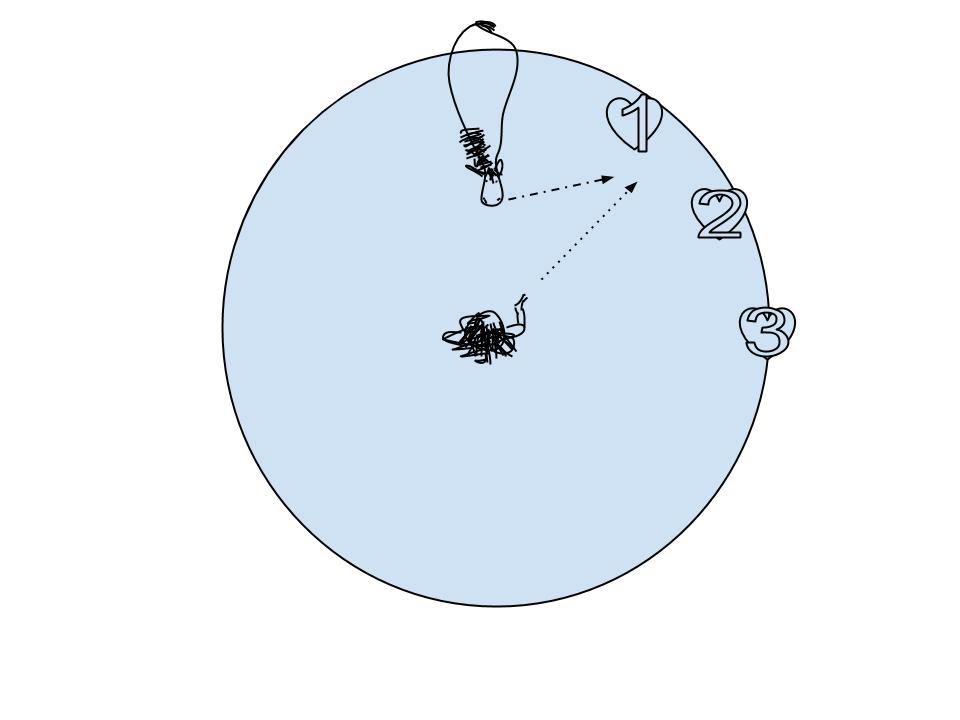
She also showed me that River is doing exactly what I’m asking her to do when I send. I have been rotating my body to “open” the circle, stepping back with one foot, and extending my arm to point to 5 or 6 o’clock. It is as if I am standing in a doorway and opening the door outward, inviting my guest to squeeze past me into the room — and then snapping at them for brushing too close to my body.

I am now practicing pointing to the spot on the circle where I want River’s nose to be when she turns and starts forward, somewhere around 1 or 2 o’clock.

circle game send

As I try this at my desk, I realize this is the same as the direct rein position in level 2 freestyle riding. Hmm, how interesting!

2. Release at the appropriate time

During our warm-up, River had trouble maintaining direction at liberty at the canter when going to the left. At about 10 o’clock on the circle, she would spin with her nose away from me (sigh) and squirt back the other direction. I tried a few techniques, such as flicking some energy toward her zone 4 when she was 180 degrees from her sticking spot (at 5 o’clock on the circle) or the “OH, you want to go right? okay, go right FASTER” game. I also tried moving in front of her to block her after her U-turn and drive her back in the correct direction. This strategy worked best, but I still wasn’t getting full circles.

Erin helped me discover that I was giving small, intermittent releases when turning River around. I’d release when River slowed, pressure her to turn and then release when she was facing away, pressure to drive her forward and release as soon as she took a step. With Erin’s guidance, I brought my energy up and kept the pressure on until River had slowed, pivoted, launched into the canter, and taken a couple of strides.

This allowed River to find a true release in upholding her responsibility to maintain gait and direction. It also communicated my directions more clearly than a series of RED LIGHT green light RED LIGHT green light. As she learns that she can trust the true release, she will seek it, and not expend so much extra energy in changing directions.

3. Delegate responsibility

Standing calmly when asked is another form of maintaining gait and direction. That means that when I back her out during yo-yo game, she can wait until she gets the next signal, which could be to come back in, or it could be to circle, or it could be to sidepass — it could be anything. It also means she can stand still for having her feet cleaned, without stepping forward to nuzzle my helmet or slobber on the saddle. The “send” in this context is my asking her “halt here” and is no different ffom asking her to “canter left” or “trot right.”

It’s about refining my control of my intention, energy, and relaxation so that River can become calm, connected, and responsive, no matter what we are doing.

Categories: Feel, Liberty, River | Tags: , , | 3 Comments

Blog at WordPress.com.