Author Archives: horsegirlonajourney

Being particular and trusting

The principles I am working on lately are “be particular without being critical” and “trust that he’ll respond but be ready to correct, not more one than the other.” I’ve had one of those “ooohhhhh!” moments, where I suddenly perceive the depth of yet another glib Parellism.
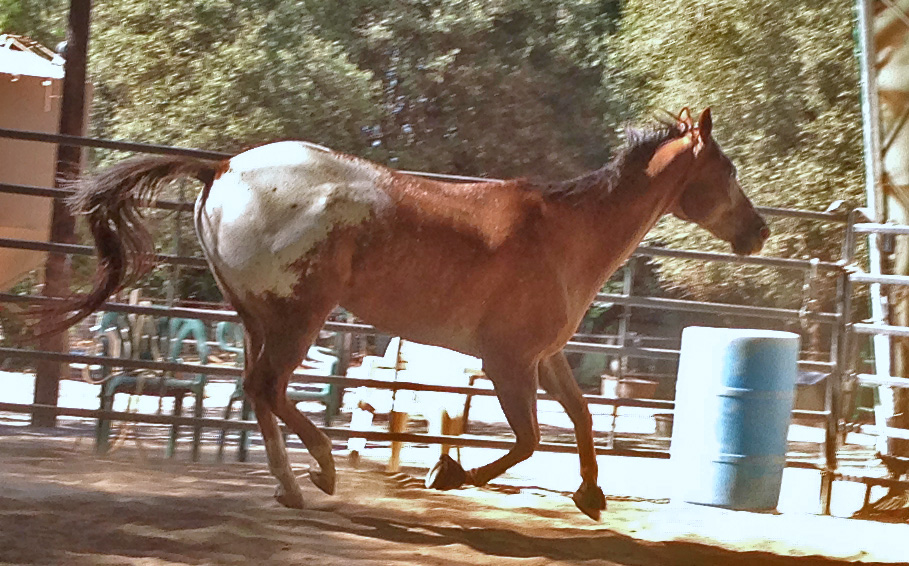
Rocky cantering at liberty

Riding with both hands on the reins and my hands up and “ready” is not trusting that he’ll respond. It’s not even being ready to correct — it’s standing there with the red pen poised over the paper, waiting for the other to dare to write a word so that I can cross it out. It’s projecting a beam of energy that says “no!” and then wondering why my partner isn’t doing something.

There is time to respond. There is time, if a correction is necessary, if my leg cue or my breath or my belly button isn’t enough to communicate the correction, to raise my hand from its relaxed position on the mane or pommel or horn and add a rein cue. “There are four moments in a second,” says Pat, describing how quickly a horse can change, how the tiniest gesture on our part can mean so much to them so quickly. And it’s okay to use more than one of those moments to get my hands in place if it becomes necessary. Someday I will be fast and smooth; for now, I am practicing smooth and slow, because my fast right now is buzzy and spastic, just hovering there to swoop down at the slightest provocation.

I have not been particularly particular with Rocky. My habit has been to blame myself for not being aware of his phase 1 of a behavior, so that by the time I become aware, it’s “too late” to address it.  (Not that I still blame, exactly, but it’s a useful shorthand.) If Rocky’s rubbing his head too hard on me, in a way he wouldn’t dare with a higher ranking horse, I blame (or credit) myself for not noticing his approach sooner, not anticipating his actions sooner. Thus, by the time the Behavior happened, it’s “too late,” because I’ve already allowed the horse’s phase 1 or phase 2 of approach.

What it comes down to is that I have not been giving Rocky enough responsibility. In my attempts not to micro-manage, I swung too far the other way.

Rocky and Smudge grooming

My heart is in the right place, in that I want to be a fair leader who doesn’t overreact. But my habit has undermined the fairness, as Rocky never knows from one day to the next whether he’ll be corrected or not, which puts in him a position of constantly having to test the boundaries and find out.

My new behavior is to respond to whatever it is, whenever I see it. To allow Rocky the responsibility to be respectful, to remove his burden of seeking the boundaries every day, and to uncritically, unemotionally remind him of his side of the partnership, when necessary. In this way, he knows I’m doing my best to hold up my side as well.

And I’m recognizing that I don’t have to respond in 1/4 of a second. I have time for an intense, measured movement that is not so swift that it blurs at 30 frames per second.

Categories: Leadership | Tags: , , | Leave a comment

Learning lessons in our lessons

“So, your homework is, the 4 phases of the go, the 5 phases of the halt, the 9-step backup, stretching those inner thigh muscles, Stick to Me on-line in zone 2, and practicing your deep seat.”

Lucky for me, this instruction was for Scott and Rocky, at the end of our two-hour lesson with Erin on Saturday. My own homework with River was similar: Stick to Me on-line in zone 2, and riding Point to Point. For riding, my goals are to activate my thighs instead of riding from my stirrups, and use the reins only to support my focus and my body language rather than as a steering wheel.

river_mountfromspool

The lesson was more like a clinic, which was awesome practice for me mentally, as my goal is to attend clinics next year. There were the two of us with the two horses, plus another student and her horse who came into the arena for the last half hour or so, to warm up for her own lesson after ours. Sometimes we did the exercise at the same time, and other times one pair would go practice at one end of the arena while Erin focused her instruction on the other.

One of the most powerful segments was the simulation of Stick to Me. Erin put Scott at her right shoulder and me at her left shoulder and then … walked. She didn’t even have to walk fast or turn suddenly for it to be challenging to stay right with her. I did pretty well, considering — I guess those 5 years of marching band weren’t wasted after all, if I could stick to Erin as well as I did without a drum major out in front.

Stick to Me
A game in which the horse has to keep a zone of his body within a specified distance of a zone of your body, no matter where you go or what you do. You start on-line in zone 1 and practice your way up to all gaits at liberty. Think of it as ballroom dancing, where if you drop the lead, your partner can wander off to the snack table without saying goodbye. And where you stay utterly tuned in to your partner so you can sense their suggestions and guide the dance that way so they have more fun.

But the exercise gave us a wonderful insight into what Stick to Me is like for the horse. Erin explained about giving the horse clear direction so that he doesn’t feel left behind, and giving him time and space to do his part, before we go up the phases. I thought of chorus lines and how experienced dancers become at sticking to each other in the right zone for the maneuver.

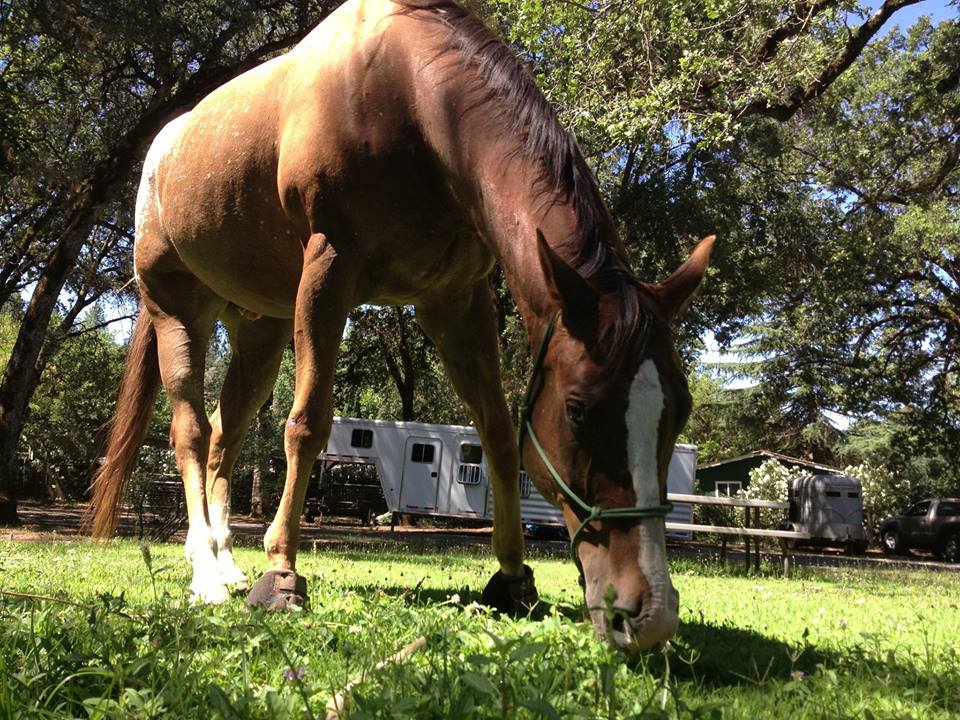
rockY_grazing

Another effective simulation was our attempt to walk at different speeds while slapping the ground with our stick and string in a steady, intense rhythm. This was to help us feel the normal human habit of confusing “intensity” with “speed.” We can get more intense without getting faster. It all comes down to rhythm. In my head, I played a half-speed version of the Imperial March (BUM BUM BUM bum BAH dummmm bum BAH dumm) and matched my stick to it, then adjusted my stride to however many steps were necessary for each beat at any given speed.

Here’s a herd of alpacas advancing to the Imperial March and demonstrating that intensity is rhythmic, not spastic.

When I started my Point to Point pattern with River, Erin coached me to smile, which had the usual effect of lightening my whole aura as well as my body. “River is serious enough for everyone,” she said. “Riding is fun! Be fun! and light! smile!” Sure enough, when I focused on my destination and smiled, River’s walk became much more free. Before that, my intense concentration was probably molding my face into a really good driving face — except that I was projecting that intense, concentrated, serious energy forward, which made a barrier that River wasn’t sure about walking through.

Let’s just take a moment to shiver delightedly at the fact that our horses can see us up there in the saddle, including our faces and thus our facial expressions, with only the slightest tip of their nose to the left or right. In fact, I’m not even sure they have to tilt….

Categories: Freestyle, Lessons | Tags: , , | 1 Comment

Blog at WordPress.com.