I’ve been “off” all week — as in off, not as in off work — and have not spent much time with Rocky, nor have I checked the Savvy Club forum three times a day or immersed myself in materials. I even decided at the last minute that I was not in the mood to call into the live session of the teleseminar this morning (if it even was live; I don’t think they specified!) and instead tuned in to a rerun later in the evening.
I have been working like crazy and juggling projects and deadlines and so I turned the volume down when the Parellis were answering questions about the levels program, the professional/instructor program, the new courses, and other business news. I’m interested! But that stuff is so far away from my life right now and the deadline for the client document I was editing was so very, very close. (I made it.) I paused in my editing during the horsemanship questions, tuned in, and took notes.
I am listing these first two out of order, as they were the most important to me.
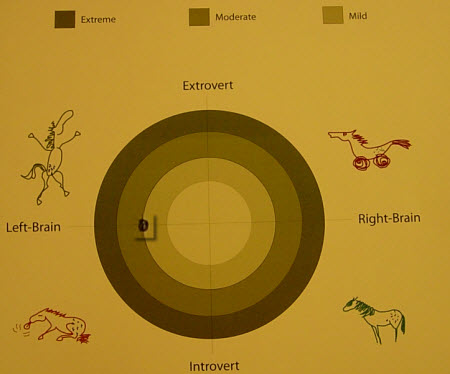
Q: Elaborate on horses being one innate horsenality. What do I make of a horse showing all four quadrants?
A – Linda: A horse has one core, predominant horsenality: he is either Introvert or Extrovert and Right Brain or Left Brain. On the horsenality chart (PDF), the core horsenality is determined by the checkboxes on the end of each axis. The little dots in the quadrants represent situational behaviors. These reflect disturbances, whether mental, emotional, or physical. They also show the way the horse reacts with you, but maybe not with other people. Horses are very reactive. The situational behaviors will improve by way you handle the horse. (Laughing, she added: Or you will make them worse, depending on how well you read the horse and respond.)
My Response: When I went through the Emotional Fitness mastery manual and saw the horsenality chart without the inner details, just the LB/RB and Introvert/Extrovert, I got a better sense of how to figure out the innate; and that means how he is when he is feeling safe, though he flips exactly opposite when he feels unsafe. When I stopped focusing on each little behavior and just went with my “feel” – what I instinctively sense as his core, versus specific little actions – I felt like I knew his innate horsenality, right there on the line dividing LBI and LBE, and on the line dividing low and medium spirit.
Q: How can I tell if my horse is hitting a threshold or just trying to dominate the situation and saying I don’t want to go there and you can’t make me?
A – Linda: A horse balks either from fear or dominance, but it’s not about the threshold. It’s about trust and how he thinks of you as a leader.

If it’s fear/unconfidence, the best thing to do is to back off. Retreat and reapproach until horse is desensitized about that threshold. He might hit another one two inches later, but if you respect all thresholds, the horse starts to trust you and will have fewer thresholds.
If it’s dominance and you smack him, it’s not going to go well. Retreat and go do something else. Rub him. Do anything to help you to keep the relationship right. Then change course and reapproach. Improve your leadership in other areas and then come back to it. Get a series of small yeses before going to the big one. We do this when trailer loading horses we’ve never seen before.
My Response: I cringed, because I feel like I handled it all wrong and reinforced the threshold rather than demonstrate that he can trust me not to push him through it. Harrumph. Learning sucks.
Here are the rest of the notes… Continue reading →


 Horsegirl on a Journey