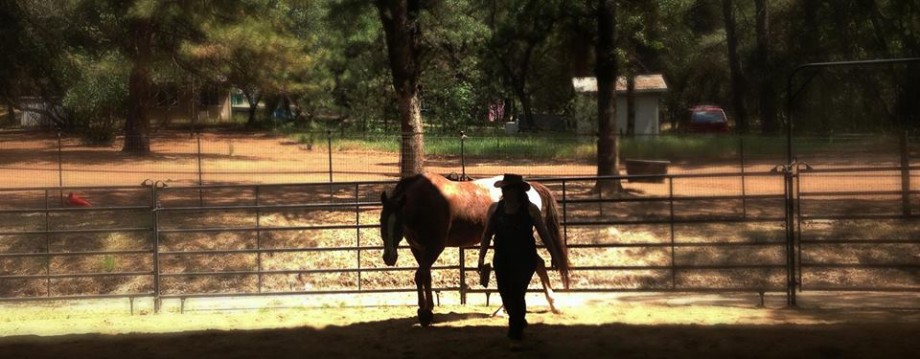
Erin and I talked about some writing projects we want to collaborate on and then from there ended up in the arena with Rocky and then Erin on the end of the line … and boy did Rocky (and I!) learn a lot.
On the Ground
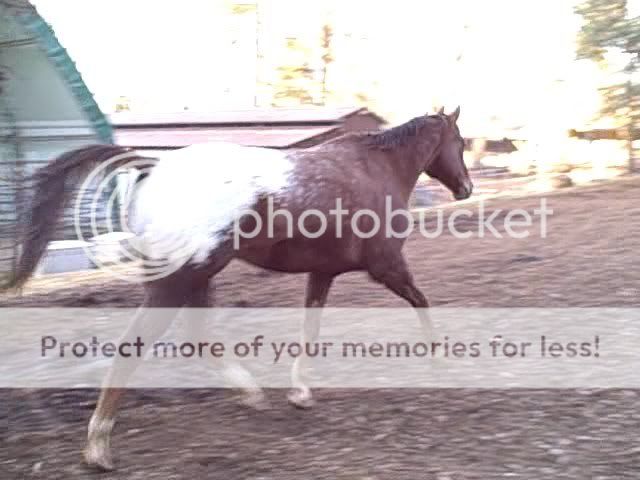 She brought up his life with some trotting, traveling with him so that the circles were large and not too stressful on his front feet. Then she shifted her energy, instantly, and tossed the rope at him, as a friendly game. And he tensed in that pre-explosion freeze of the RBI. He would fling his head up and brace, and if he started to go inward, she jerked the line, hard but in rhythm 1-2-3, to bring him out of it. I think that’s the first time I’ve seen a “thanks, I needed that!” performed in person, and Rocky’s facial expression was priceless. A combination of irritation (“but I was going to my happy place!”) and surprise (“what are you doing?”) and anxiety (“what am I supposed to do instead?”).
She used the three principle games to teach him a new response to stimuli.
Friendly Game
She tossed the rope over his back and slid it off toward her, in rhythm, not especially hard but not wimpy either. She kept her energy loose and soft and even whistled a tune to emphasize that this was all friendly. (I can’t whistle lately, it’s so dry and cold, but I sing a lot when I ride, so I will sing instead of whistle when I play friendly.) He tried several things. Tense, freeze, leap, fling head up, pull back, brace, resist. None of that stopped the stimuli. And he couldn’t retreat inside because she would see the beginning of it and cause it not to happen.
Porcupine Game
She applied a bit of pressure on the line to show him that if he lowers his head, the stimulus stops. This is a familiar game to him, as I have done this as part of our “follow the feel” practice. When he followed the feel, he created slack in the line and the rope-tossing stopped. If the rope was on his back at that point, she left it there, so that she didn’t add stimulus by sliding it off. She waited for the lick and chew before starting again. In this way he learned that while all of his other strategies didn’t work, this new strategy did. It took him a long time to learn to do it on his own — much longer than it usually takes for him to learn something new, which showed just how worried he was. But I was just bursting with pride, because I could see him start to figure it out, licking and chewing like a kid on Halloween, concentrating with his full attention on Erin and then occasionally flicking an ear and eye toward me with a “is this okay?” question.
Driving Game

After he started to get the idea that this is what we were doing (and that he wasn’t going to get out of school early), she added some driving. She would intensify her energy to drive his hindquarters or ribs away as needed, using the rope. Then when he moved appropriately, she immediately dropped her energy into friendly, tossing the rope. She showed me that at this stage, she was giving him some time to figure out the difference, and was not expecting him to instantly respond appropriately to driving and then to friendly. She was teaching him what happens before what happens happens, being consistent with her energy and her timing.
On the Horse
I’ve wanted Erin to ride Rocky for a long time now, for several reasons, including to get her take on his soundness and soreness levels and to see if he did the same “but I don’t WANNA go forward” with her than he has started doing with me. I’ve been wondering if the balking was because I, deep inside, didn’t really want him to go forward. Or if it was because a rider on his back takes the ache in his feet from minor annoyance to actual pain.
I did tell him the other day that I have plantar fasciitis (chronically inflamed tendons from heel to toe) and metatarsalgia (which just means “pain in toes/ball of foot” but isn’t it a cool word?) and possibly a bone spur in my left heel, and that playing with him on the ground in the sand of the arena is painful for me and almost excruciating later (mornings especially, as the tendons have all night to get tight and inflamed). I said, “I empathize with you, but you’re the one who gets Adequan!” Heheh.
Go
He did balk with Erin at first and she even said something about him preparing for a buck — I said no, he would never be so rude — and of course he did not buck. He’s a NICE horsey. Or maybe remembers being brutalized for such behaviors by a previous human, and so he holds it in. (I suppose as he gets more confident he will feel free to express himself in that manner, but so far he has restrained himself.)
She stayed consistent with her phases and once he started going, he went along pretty well. She rode in the bareback pad and halter, with the 12-foot line tied into reins. She used the reins only after he didn’t respond to her body, and when she used rein, she used only one at a time. She has a way of holding the rein at the midpoint and then using the other hand to lift or bump the left or right if necessary. He had a nice walk and a nice jog and did not bob his head or limp or go uneven on the straight lines. A small circle change of direction did cause him to be off, so she advised that I not ride him in anything smaller than the arena, and do my direction changes in a wide arc and across the diagonal. More like a yin-yang symbol than a circle or small figure 8.
She had him canter, too, and he was smooth and slow, and she was surprised at how well he collected himself up, as she wasn’t asking him for Collection. I told her how much effort Jenni put into teaching Rocky to engage his hind end and “push” rather than scramble his front end and “pull” (thank you, Jenni!). He used to canter so heavily on the front end, it felt like he was just churning his legs in an effort not to fall on his face. He still has much more trouble cantering to the right but even that is much improved — I could see him bringing his hind legs much further under his belly than he used to, even to the right, and that made me feel good about his current lifestyle.
It is the first time he has cantered with a rider since we moved here a year ago, what with all the lost shoes, then barefoot transition, arthritis, and two months of thrush, plus my own worry that I am not good enough to be in harmony with him and I don’t want to be a burden or put him off cantering.
Whoa
Erin showed me the difference between riding (go) and not-riding (whoa). Rocky did not respond to her body at all, so she used one rein for a stop-and-back. She had to go to phase 3 for that, which meant the snap was clocking him on the jaw, giving him aural as well as physical feedback. She said if he responded in any way, even just an ear flick, to the change in her body, she just picked up the rein until he stopped and she didn’t ask him to back, and they had a rest until he licked and chewed (or got distracted by something else). But for no response, he got a firmer signal, because her goal was to teach him — say it with me — what happens before what happens happens. She chose to back rather than just halt because that also made her message more clear.
 She said he is easy to stop, he just hasn’t learned the body cue, so I am to work hard at making my energy and body language clear and consistent and to give him some time — about three seconds — to respond to my body before I pick up the rein. Again, I will practice in simulation before I practice on him. (I’m practicing right now, on the stability ball I use for an office chair.)
She also exaggerated her fluidity movements for me so that I could see the difference between going with him, going ahead of him, going behind him, and not going. She breathes out, audibly and completely, when she stops riding, and said that some horses get so tuned in to the breath that they’ll stop even if all you do is sigh heavily. I say “Whooooaaaaaaaa” and she said it’s fine to keep using the verbal cue. Rocky is an extremely verbal horse, which will be an advantage if he loses his sight, and “whoooaaaaa” is handy to use when on the ground as well.
Ride, Regina, Ride
She said he felt very good on the straight lines and fine on the wide turns. I am cleared to ride! She agreed with me that combining arena with ranch trails would give us a lot of interesting terrain and straight lines to play with. It’s a balancing act between circulation (good!) and inflammation (bad!). We also talked about judicious use of pain management such as bute or equiox or banamine, using it sparingly and only on days when I ride. I’ll talk to Dr. White about the options as I do not want to relieve one problem only to create others, like ulcers or kidney damage.
Even on my best weeks I only ride a few times a week, and my Ultimate Riding Goal is pretty simple: trail riding, hanging out at the ranch, savvy play days. Lots of walking, and very few sharp turns or tight circles. (No barrel racing for us, not even Parelli-style.) I am feeling hopeful again about riding as giving him a day off between rides is totally fine — my challenge will be riding him as frequently as every other day! — and treating the pain issues appropriately on an as-needed basis.


 Horsegirl on a Journey