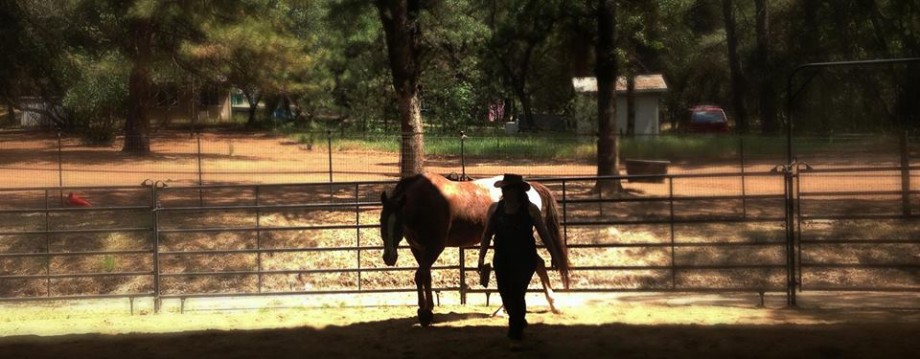
I’m back in my usual ficton, the time and place that includes Rocky and Salsa. Salsa was happy to see me insofar as he noticed the carrots in my pocket. Rocky gave me a “talk to the hoof” look and walked off to a pile of hay (but spoiled the effect by watching to make sure I noticed his ‘tude).
My latest Parelli workbook arrived while I was away and I poured myself into it last night. This month’s topic is RESPECT, which thrills me, as I am working on that with both horses these days.
This is the manual that Linda talked about at the gold summit, where she said that she realized that in 20+ years of teaching horsemanship, she had not actually written content focused entirely on respect. It always showed up as a component of other subjects. And yet respect is the second on the list of 10 qualities that make a horseman.
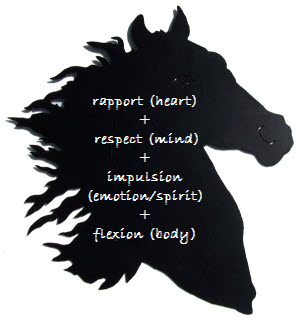 Respect is the second building block of natural collection. It is also the foundation for leadership, and leadership among horses is now my biggest challenge. (I should pat myself on the back for that, as before I got Rocky, an unexpected but powerful fear had risen inside me, and my biggest challenge was working through that. Now I don’t even have a lot of fear when riding, other than my tendency to worry that I am doing/will do the wrong thing.)
When my leadership behaviors and energy become more habitual and effective, Rocky and I will become one of those teams that make other people say things like “you are so lucky to have such an easy horse.”
The respect manual includes several checklists for assessing where you and your horse are right now in terms of mutual respect. On the questions where you give a rating, rather than a Yes/No, I realized that I was rating us too highly overall. The scale is from 1 to 10 with 10 being “the most awesomest you can imagine,” and I was rating us in the 4 to 6 range on several things.
But then I realized that like Han Solo, I can imagine quite a lot. I made a note to myself in the margin that I should knock most of those scores down a couple of points, for comparison in six or 12 months.
The Yes/No questions were the hardest, though. These are not essay questions. You have to strip away the caveats and ‘splainin’ and defensiveness (“but I’m getting better!”) and put the truth down on the page. Then in six months, you come back and fill it out again, using only Yes or No, and see if you have managed to change your truth.
Let me show you how painful this is, with questions picked at random from a couple of sections, and my answers — including caveats, ‘splainin’, and defensiveness. Just by way of a f’r’instance.
From “Things That Decrease Respect”
- Do you corner your horse to catch him? (No, and I never have to.)
- Do you saddle him before he is ready? (Yes, in that I think I still do miss some signals. His recent resurgence of cinchyness has a silver lining in that I am learning to see what happens before what happens happens, and he is only needing to go to phase 1 or 2 with me before I understand.)
- Do you ask him to do things he’s not prepared for? (Yes. This is another reason I suspect he is indeed innately RBI even if it doesn’t exactly say so on the behavior examples on the horsenality chart. Because he is gentle and obedient, I don’t always see when I’ve done one too many “good job, now let’s make it harder.”)
- Do you micromanage? (No. I used to, in my normal days, but now I err too far in the other direction.)
- Do you lose your balance easily? (Yes, although not nearly as much as I used to. And how interesting to think of this as a sign of respect/disrespect!)
From “Signs of a Lack of Respect”
- Does your horse nip or bite you? (No. Except for recent cinch issues, when he displaces his desire to nip by chewing on his rope, the wall, or the saddle.)
- Does your horse keep heading for the gate? (No.)
- Does your horse run away from you? (Yes. I did not think so, but then I realized that when our draw breaks — when he looks at other things in the arena, or to the outside, or does not come to greet me in the pasture — all of these are subtle signs of “running away.” But he doesn’t actually run. )
- Does your horse push you around, make you move your feet and give ground? (Yes. Not nearly as often as he used to now that I recognize his coming so close as dominance rather than insecurity.)
- Does your horse brace against you (your leg, hand, rein)? (Yes. Sometimes.)
I’d rather rate them all on a scale: never, rarely, sometimes, usually, always. But the stark yes/no does not allow excuses or wiggle room and makes the tool more effective. Now I have some specifics to start with, including a list of things that diminish respect (and therefore, an implied list of things to do that increase respect.) “I need to earn their respect” is too broad to be helpful.
The devil’s most devilish when respectable. ~ Elizabeth Barret Browning


 Horsegirl on a Journey