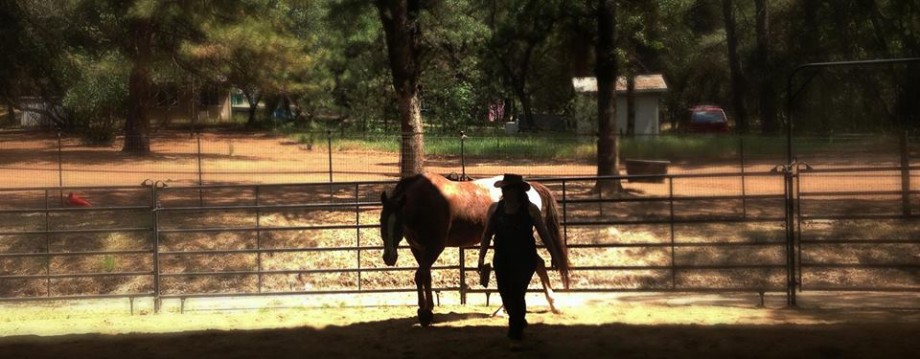
Not long ago, I posted five questions about providing language and leadership on The Walk, questions I intended to ask Erin in my next lesson (Location-Based Relationships, 11/10/09). Once again we have not managed to synch our schedules and so I have not had a lesson with her. However, continuing to putter along in the journey has given me some answers, for now and to build on as we move forward.
Am I shoving Rocky off cliffs with my approaches to various thresholds or am I respecting the thresholds and helping him gain confidence?
I must be handling at least most of the thresholds appropriately, as he has been meeting me at the gate even during hay time, and bumping the halter with his nose in a very obvious “let’s go let’s go” way. He asked me questions several times during our family walk on Friday.
When he planted all feet and flipped his head up to look, I looked where he looked, and gave him some time, and then when he started to relax, I would apply a little bit of pressure and say “Okay let’s keep going” and he would fall into place behind or beside me.
This pressure was not always physical, as I use our verbal cue of “Ready? Let’s go!” first, and then I would take a step or two with slack in the line. (This is in preparation for his losing his sight entirely. Sigh.) When that didn’t work, he did get a bit of porcupine game on his poll. He never once resisted stepping forward, nor did he leap about or spaz or get less trusting as the walk continued.
I think looking where he looks is a good strategy, better than continuing to focus on down the trail. When I look, I show him that I respect his alertness, evaluate the situation, and answer his unspoken question: Is it safe? Yes, it’s safe.
How much can I allow him to eat of the grasses and plants along the way without making him sick?
He can snack for two hours of walking and end up with things a bit green and soft, but with no ill effects. (Note to self: Find way to rig a harness so he can carry his own muck shovel, if we go back to eat at the restaurant outdoor tables again.)
How can I be more effective about enforcing the rule of walking behind me (knowing that Rocky spent 7 years being taught to put the human in Zone 2 before I got him)?
I decided to try it his way and walk in zone 2 (shoulder), and sometimes even take the initiative to walk in zone 3 (ribs). I used driving game with the rope as needed and hopefully my intention of “I’m leading you from the place where I’d be sitting if I were mounted” came through, rather than “you’re in charge ’cause you’re in front.” He still looked to me for direction and he did not crowd me. When I wiggled the rope to yo-yo him back or at least to slow him so I could move to zone 1, he responded well. The drawback to this is that when on the ground, I cannot see over him, so I can’t quite simulate riding — I can only see half of our environment.
Is it dangerous to allow Rocky, specifically, to power into fast trot, canter, and gallop on the uneven ground at the school?
Yes. He stepped in a hole at the walk and had to wrench his foot out just a little bit. Had he been going faster, he might have fallen or worse. So henceforth the school fields are a walk-only zone. We can save the higher gaits for the trails along the way and at the park, the arena in the park (when I find it; I know it’s there, though, somewhere!), and here at the ranch.
How do I “match his energy” or “match his energy and add four ounces” effectively?
This one still eludes me. It’s a matter of getting it out of my brain and into my body, though, which means practice, and being patient with however long it takes. I notice that I tend to “flap” rather than “move” — that is, I can wave arms or do jumping jacks or whatever, but it’s a lot of flurry of limbs without much core intensity to it. Erin moves slower but with much more intensity, so I shall have to stalk her and mimic her as best I can. And of course watch more of Pat and Linda. Maybe more dancing and Pilates, which would solve a lot of things, not just horse body language. Heh.


 Horsegirl on a Journey