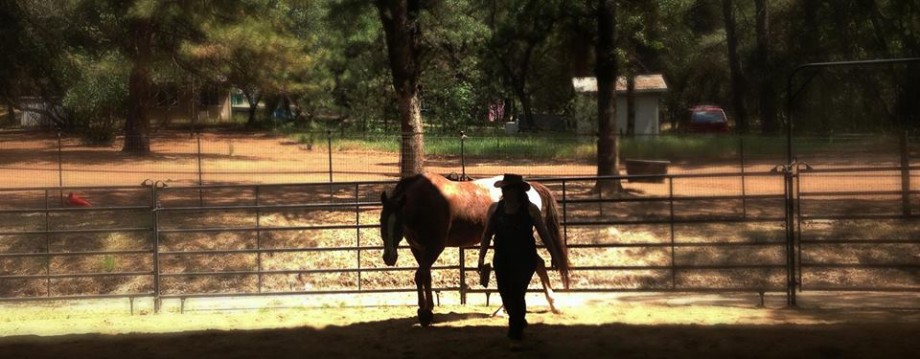
Your assignment today is only to steer, not to stop or slow Rocky. I don’t want you to hold him back. Keep him lined up behind Bautisto and if he gets too close, have Maddy swing her string to back him up. ~ Erin Murphy to me at the start of our instructional trail ride
While my sharpest memory of the view is of the black dorsal stripe down Bautisto’s beautiful Andalusian haunches, I happily report that this advice from Erin has been powerful, resulting in more confidence and better partnership on all of the rides I’ve taken around the ranch since.
On Wednesday, Jan and I took an instructional trail ride with Erin Murphy at Empire Mine State Park. Jan rode River, mostly as a passenger but sometimes as a leader, and was ponied by Erin or her intern Maddy. I mostly rode Rocky on my own, but also got down and walked about a mile. I didn’t want Rocky to experience any tightness or anxiety from me in the saddle and when he slipped a few times on the pine needles, and when we reached steep downhills, I hopped down and walked. It’s easy enough to get back on when we come to a rock or fallen log I can use as a mounting block.
Erin’s instructional trail rides start when you get your horse from his pasture and end when you put him back — in our case, about three hours. Of the four humans and four horses, I was the only one who had anxiety about the trailer. I was able to articulate to Erin that I’ve had so little trailering experience that I didn’t know what was normal and what was an emergency. (“Is River kicking the stud divider?” “No, she’s just shifting her weight.” “Oh.”) We talked about the day’s plans while the horses munched their hay in the trailer. Allowing the horses time to relax after loading removes any kind of get in and GO! energy, and pretty soon after that we pulled out smoothly for our adventure.
I am so much better in the saddle now than I was last year. I still lean forward and also have my feet too far forward and therefore my balance is still off which in turn affects Rocky, but I’m much closer to the sweet spot, and I can stay in the sweet spot longer — and I notice sooner when I’ve gotten out of alignment. I can tell the difference in Rocky’s walking and trotting, and get my body back in position so that I’m not interfering with his movement or causing him discomfort, which in turn gives me more practice developing my independent seat.
But I am good enough in the saddle these days to stay with Rocky when he spooks to the side and not to even have a surge of adrenaline when it happens. I’m good enough not to worry about surges forward, which happened on the trail when a gust of wind spooked all four horses forward. My response was to put my hands forward and push myself into the saddle; I didn’t pull back or lean forward or restrict him in any way, and he stopped after a few strides. He was much more relaxed than Erin had expected him to be, and she congratulated us both on our progress.
This confidence in the saddle has let to me riding all over the ranch, including on the narrow paths between the cottage and the shop, and across the seasonal creek. The slopes that used to worry me no longer do. I’ve changed my thinking from “Rocky stumbles a lot” to “Rocky is so athletic and skilled at staying upright,” which is also true.
We played a lot of games on our trail lesson. The whole excursion was a friendly game for us all, getting us all accustomed to things like bicycles, runners, dogs, babies in front packs, and strollers. Also rocky creeks and slippery pine needles and horse-eating boulders and the occasional plastic grocery bag wafting across our path. Also other horses and riders going past, which is a challenge for River, who stares intently with her best Sweetie Face on, causing others to croon “oh what a pretty girl, such a cute horse!” while we all keep our faces blank. What on another horse is indeed a sweet face is actually River’s “I want to get close to you and then squeal, wheel, and double-barrel your chest” signal. River also stares at dogs, thinking dark thoughts.
Erin had Maddy and I play a yo-yo game in which Maddy backed Bautisto in a straight line and I was to keep Rocky straight behind him. I wasn’t to back Rocky, only to steer him, and to let Bautisto and Maddy take care of the driving in reverse. This was challenging to all four of us for different reasons: Maddy, backing her own horse while also driving mine (and having to coordinate her reins, body, legs, hands, and savvy string); Bautisto, in having to back even though Rocky was right there; Rocky, in having to go in a straight line instead of swinging to the side; and me, in resisting the reflex to lift the reins and back Rocky myself.
Erin had Rocky and me follow her for a bit and when he crowded Hermoso like he’d been doing to Bautisto, she used driving game with her savvy string. She used a more energetic phase than Maddy had been using, and Rocky ran into the string with his nose hard enough to sting. And after that, he gave them about a yard of space.
We played follow the leader and traded places here and there and discovered that all four horses were most comfortable in this order: Rocky Hermoso River Bautisto. Rocky was a little too alert for me in the front, so I directed his (and my) attention by asking for sideways game left and right as we rode forward on the fire road. He was more comfortable walking next to Hermoso and leading by a head rather than single file. After an unexpected “slide stop” on pine needles on the downhill, I dismounted and walked in front, and Rocky liked that most of all. (“He likes to be in front but behind his lead mare,” said Erin.)
Figure 8 patterns helped in the beginning when Rocky didn’t want to stand still after I mounted and while I was tightening my girth. We played squeeze game with the creek, with each other, and with the gate at the start of the trail.
On the drive home, I had a multitude of emotions churning inside me. Anxiety, excitement, despair, joy, love — all the feelings I saw coming up during the ride and set aside to process later, as it wasn’t fair to ask Rocky to be left-brained and focused if I couldn’t do so myself.
The main thing now is to keep arranging my work schedule so that I have a weekday morning free every week or two for lessons, so that I can build on my learning and keep progressing toward solid level 2 freestyle riding skills.




 Horsegirl on a Journey