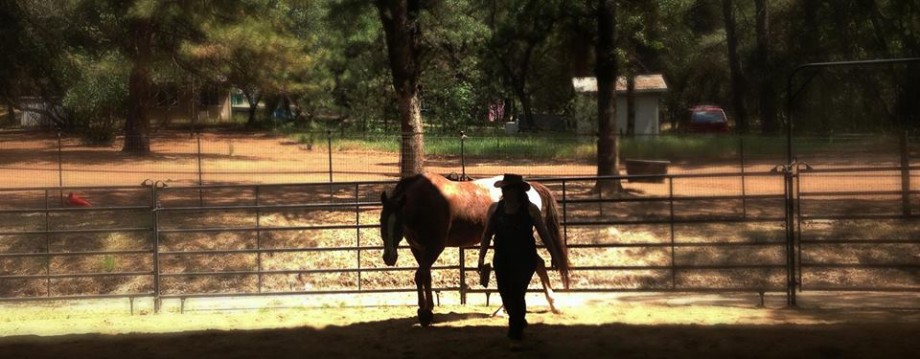
Today I rode River in Rocky’s saddle. Rocky is 16.1, lanky, high-withered, deep from withers to breastbone but narrow from left side to right side.
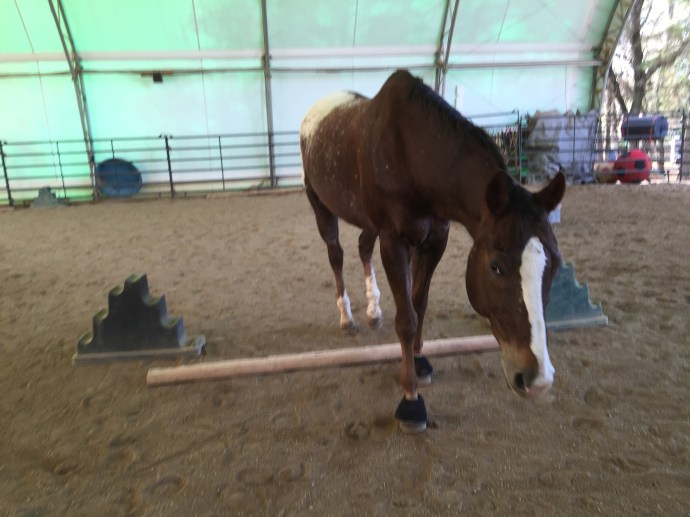
River is 14.3, stocky without being stout, and rounded at the withers.

Yet when I set Rocky’s saddle on her on a whim, it didn’t rock front to back. When I put my hands under the tree, I couldn’t feel any pinching or bridging. When I lifted her front leg to check the farthest point of the scapula, the saddle had room for her shoulder to move.
My favorite part of Rocky’s saddle is the wide channel between to bars of the tree. Rocky has plenty of room for his wiggly spine to sway without bonking into the saddle. This width appeared to work for River too.
I allowed her to eat at the hay bag for a long time just to get used to wearing to saddle. Then we played on the ground for a while to make sure she could move comfortably and accept the saddle. Eventually I took off her halter and climbed aboard to practice carrot stick riding. We had the arena to ourselves so I didn’t feel like I needed to have a rope on her “just in case.”
What I learned in our walk-trot transitions and our turns is that if I got off balance to one side, the saddle would slip that way. I see Pat adjust his saddle back to the middle all the time, so I decided to treat it as an opportunity for learning — incentive for feeling a balanced or unbalanced seat on tight turns! — and not reflexively cinch up tighter.
River did not seem bothered by the saddle even when I slipped to the right on the first turn, so we practiced transitions and turns and halts until I felt like I’d improved, and then I got a halter and reins to ride one loop around the ranch trail. It was hard to keep it to just one but that’s good — leave the party while you’re still having fun!
In grooming her afterward, I palpated for sore spots and felt for dry or unusually sweaty spots, and found no signs of discomfort. As always we will have to try a few times and see what happens. But it would be nice to be able to have the same type of saddle for both of them and thus not always be switching between types of seats.



 Horsegirl on a Journey