Posts Tagged With: horseback riding

Oh boy! An opportunity! Riding when things are Different

All of the horses from the Back 40 were in the two arenas today while Eddie used the tractor to move the Back 40 manure pile down to the main manure pile. Rocky is nervous about the tractor when the bucket goes up, although he doesn’t mind it when the shovel is lower than the driver’s head. I thought “what a great opportunity to play with the Touch It pattern in the Back 40, on-line at first and maybe from the saddle!”

Touch It – This is a way to play the You’re Getting Warmer game with your horse. The more you do it, the more you realize just how deep this game can go, and how powerful it is for building your horse’s confidence and your own communication skills. The keys that make it a game are:

  • send, don’t lead or drag or force, the horse to the spot
  • allow the horse to figure out the puzzle
  • match the pressure to the moment (“colder, colder, you’re getting warmer!”)
  • as your horse masters the game, make it more interesting by making it more challenging

Not that long ago, I would have thought, “sigh, guess I can’t ride today, the horses are galloping in the front arena and the tractor is zipping up and down the south side of the ranch.”

I took Rocky into the Back 40 to play Touch-It and “get him used to the tractor.” As it turned out, Rocky didn’t worry about the tractor. He was much more interested in sniffing every load of manure that had not yet been scooped. So we played Touch It with manure first, and then graduated to various trees, stumps, cones, and sticks. As we played, I noted where the hazards were for riders: low branches, high roots, electric fencing.

Half an hour later Rocky had vacuumed up the wisps of hay that were left over from the morning, still without reacting to the tractor even though we got pretty close to it. I decided that was good enough and brought him back down to the main ranch for riding.

We did great. I finally realized that the reason Rocky always heads to the north side of the main drive is that the slope there is less steep than the south side. Duh! I listened to him and helped him find a gentler route down, and on every circuit we made the same switchbacks. By the fourth or fifth circuit, he was no longer hesitating at the top of the slope, but walking willingly along our switchbacks. I apologized for not figuring that out ages ago.
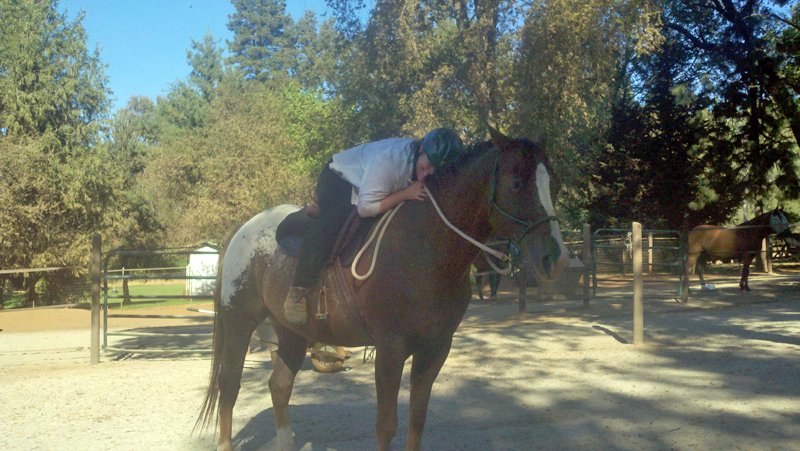
 

Our conditioning plan called for mostly walking with a few trot transitions, so we did those at the west edge of the loop, where the slope is flattest and the footing is the most even. He only stumbled twice: once at the walk when he got distracted by the galloping in the front arena, and once at the trot when he didn’t pay attention to a dip in the road. In fact, that was our best trot of the whole session, a nice relaxed easy trot (more than a jog, less than a pogo stick) that I sat instead of posted.

It was so good and I’d been in the saddle for 40 minutes at that point, so I ended the riding portion of our session. He got a snack and a hosedown and then we walked around while the Back 40 horses were put back. We ended with a lovely roll in the deepest sand in the covered arena and a couple of carrots in Rocky’s pen.

Categories: Freestyle | Tags: , , | Leave a comment

Clinician Highlights: Lynn Palm at Horse Expo 2012

Lynn Palm’s session was called “Be Positive: Your Horse Knows Every Word You’re Thinking.” She focused on showing the results of keeping our thoughts on a positive path.

“Positive” in this context doesn’t mean unfounded optimism. It means phrasing our thoughts around the outcome we want (“we will trot evenly around this circle”) instead of what we don’t want (“oh god what is my horse going to do next, she’s so spooky, ack, she might shy at that, ack!”).

In Parelli lingo, this is “the natural power of focus,” and it goes much deeper than just “what we want.” Whatever has our complete focus is what will happen. There is no other outcome. It will happen, because it is the only thing than can happen.

If you can focus 100 percent on “we will trot evenly around this circle, with rhythm and relaxation and contact,” that is what will happen. Your horse can then share your bedrock certainty. Ah! yes! we will trot evenly around this circle! those billowing tarps and flapping flags and whipping branches and swirling dust devils are not the droids I’m looking for!

If you focus 10 percent on that and 90 percent on possible spooks, distractions, and disasters, you are going to get spooks and distractions, and possibly a disaster.

20120613-123232.jpg

In fact, just now, it hit me how rare the disasters actually are, relatively speaking; it tells you something about the horse-human bond that horses manage to stay disaster-free most of the time, even in our fear and lack of focus.

When you look down, his mind is in front of your mind. Keep your eyes ahead of the horse. ~ Lynn Palm

Lynn said that when we catch ourselves looking at our horse, or thinking “why is he doing this, what will he do next,” that’s a sign that we need to relax, slow down, think about something else, be casual, breathe, and ride through it.

She didn’t mean ride through an explosion. What she described sounds awfully close to Linda’s teachings on handling thresholds.

The more the horse wants to look, the more we need to let them. Stop on a loose rein. The more they look, the more chance they have to settle. ~ Lynn Palm

Like Chris Cox in his session about rider confidence, Lynn coached her student on physical balance. Breathing — “in sets, inhale and exhale” — and relaxing were key. Even just that made a change in the horse.

At first, the student had her hands wide, below the crest of the neck. Her arms were stiff — her whole body looked rigid — and any time the horse even hinted at shying, raising her head, moving sideways, or some other “unexpected” move, the rider clenched tighter and jerked on the reins.

The horse expressed her own discomfort through tense, jerky motions, and by flicking her tongue all around. Even when she kept her feet relatively still, her tongue was in motion, sticking out of the side of her mouth, rolling the bit, flapping up and down.

I watched the horse and rider escalate in a cycle of nervousness and thought ah, yes, I remember that. Many of my normal lessons went just that way.

The first change Lynn suggested was for the rider to raise her hands and move them forward. With the rider’s hands in front of the horn and above the mane, she could not lean on the reins to balance. She also coached the rider through looking ahead, not down, and had her tie the reins in a knot without looking at them and drop them over the horn.

While an assistant managed the horse on a longe line, the rider practiced raising her arms, then making a T, then resting her hands on her thighs, then picking up the reins without looking at them, then setting the reins down again. All while looking where she wanted to go.

When the rider let go of the reins and began to do other things with her arms, finding her balance point, the mare reduced the tongue action considerably. The longer the rider stayed off the reins, the more relaxed the mare’s entire body became, and the less we saw the tongue.

Parelli reminds us that the more we use the reins, the less they use their brains. I can’t help but think that many people prefer that their horses not use their brains, because the people do not trust their horses. They feel safer on horses that give up trying to use their brains and go dully where the reins drag them instead. These riders feel safer or smug with the illusion of control because they don’t realize it is an illusion.

In Lynn’s session, the looser the reins, the more relaxed the horse, which calmed the rider, which calmed the horse.

I ride Rocky now with the understanding that he will communicate with me in phases, not “suddenly for no reason at all” transmogrify into a bronco. It took me a lot of ground time to develop that trust.

Our horses are our mirrors. They are quick to feel a change in us, to provide release for us, and to reward our slightest try. We just have to learn to do the same for them.

Categories: Events, Freestyle, Lessons | Tags: , , , | 3 Comments

Create a free website or blog at WordPress.com.