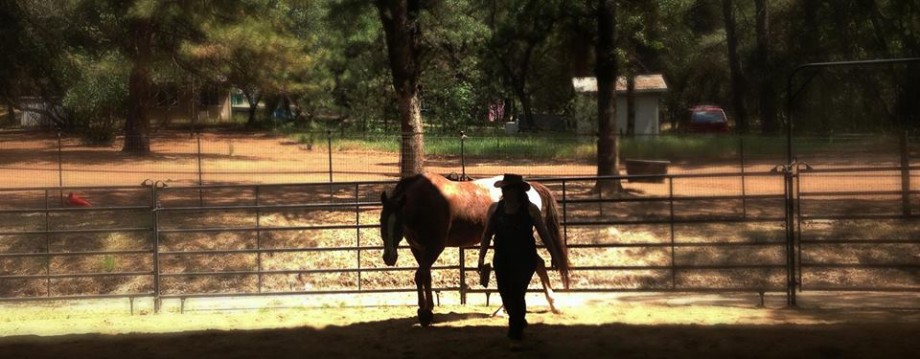
Erin interrupted herself in my lesson today, apologizing half-seriously. “I’m picking apart your send. I’m so picky! Picky picky picky!” I laughed and told her that’s what we hire her for, that I appreciate her attention to detail. “I’m picky with you because I know you can take it,” Erin said then.
Take it? I crave it. Erin excels at separating each step of a process, isolating and fixing the techniques that are causing problems, and recombining the steps into a process that works.

Today, the circle game at liberty proved powerful. River became not so much a mirror as a microscope. The cause of the problems was my send, and the solution was threefold.
1. Refine my phases
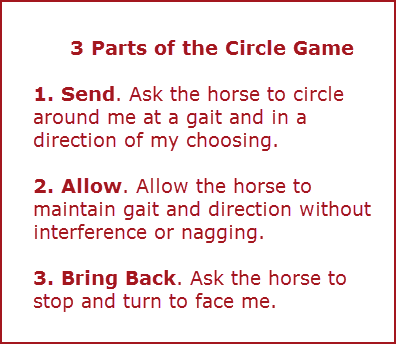 In Parelli level 2, we learn to give the horse a long phase one and then if necessary a quick two-three-FOUR. We also learn about tagging the ground, not the horse, so that the horse has time to move forward and “win” the game by not getting tagged.
What I have ingrained in my body motion is to go up two-three–FOUR! with FOUR! being a loud, strong whzzzzzzWHAPP on the circle at 12 o’clock. Typically, River moves off of 12 o’clock just in time, slowly but impudently, and swishes her tail to show her disdain.
What Erin sees happening is that I am dulling River to the whzzzzzzWHAPP. And that it looks like I am threatening her, when I raise the stick and string and focus so intently on the spot and then “attack” it so hard. At the same time, I leave myself nowhere to go if I need to escalate, and I have convinced River that I’m usually not going to touch her so she doesn’t really have to get a move on.
Erin helped me refine my phases to be effective without threatening.
- Point.
- Add voice cue.
- Lift stick.
- Wiggle stick.
- Flick horse with string. A flick with intensity, but not a big loud fast overhead whzzzzzzWHAPP.
She also showed me that River is doing exactly what I’m asking her to do when I send. I have been rotating my body to “open” the circle, stepping back with one foot, and extending my arm to point to 5 or 6 o’clock. It is as if I am standing in a doorway and opening the door outward, inviting my guest to squeeze past me into the room — and then snapping at them for brushing too close to my body.
I am now practicing pointing to the spot on the circle where I want River’s nose to be when she turns and starts forward, somewhere around 1 or 2 o’clock.
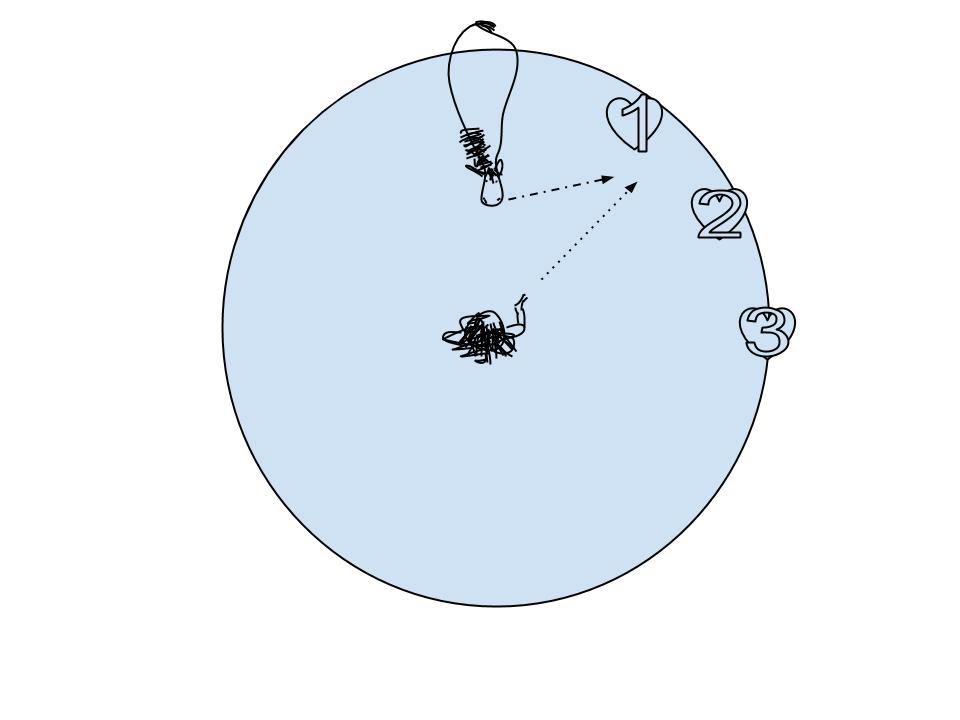
As I try this at my desk, I realize this is the same as the direct rein position in level 2 freestyle riding. Hmm, how interesting!
2. Release at the appropriate time
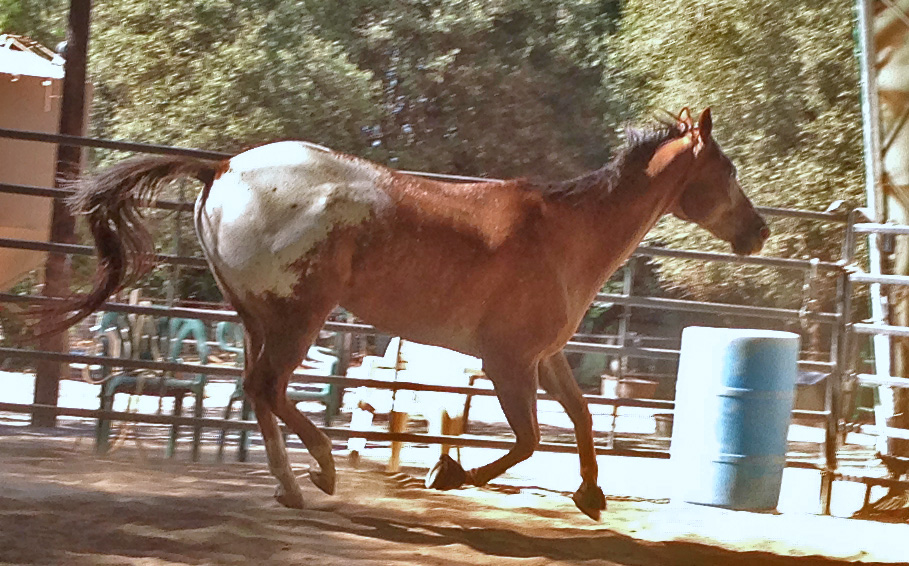
During our warm-up, River had trouble maintaining direction at liberty at the canter when going to the left. At about 10 o’clock on the circle, she would spin with her nose away from me (sigh) and squirt back the other direction. I tried a few techniques, such as flicking some energy toward her zone 4 when she was 180 degrees from her sticking spot (at 5 o’clock on the circle) or the “OH, you want to go right? okay, go right FASTER” game. I also tried moving in front of her to block her after her U-turn and drive her back in the correct direction. This strategy worked best, but I still wasn’t getting full circles.
Erin helped me discover that I was giving small, intermittent releases when turning River around. I’d release when River slowed, pressure her to turn and then release when she was facing away, pressure to drive her forward and release as soon as she took a step. With Erin’s guidance, I brought my energy up and kept the pressure on until River had slowed, pivoted, launched into the canter, and taken a couple of strides.
This allowed River to find a true release in upholding her responsibility to maintain gait and direction. It also communicated my directions more clearly than a series of RED LIGHT green light RED LIGHT green light. As she learns that she can trust the true release, she will seek it, and not expend so much extra energy in changing directions.
3. Delegate responsibility
Standing calmly when asked is another form of maintaining gait and direction. That means that when I back her out during yo-yo game, she can wait until she gets the next signal, which could be to come back in, or it could be to circle, or it could be to sidepass — it could be anything. It also means she can stand still for having her feet cleaned, without stepping forward to nuzzle my helmet or slobber on the saddle. The “send” in this context is my asking her “halt here” and is no different ffom asking her to “canter left” or “trot right.”
It’s about refining my control of my intention, energy, and relaxation so that River can become calm, connected, and responsive, no matter what we are doing.



 Horsegirl on a Journey