Posts Tagged With: parelli natural horsemanship

Clinician Highlights: Lynn Palm at Horse Expo 2012

Lynn Palm’s session was called “Be Positive: Your Horse Knows Every Word You’re Thinking.” She focused on showing the results of keeping our thoughts on a positive path.

“Positive” in this context doesn’t mean unfounded optimism. It means phrasing our thoughts around the outcome we want (“we will trot evenly around this circle”) instead of what we don’t want (“oh god what is my horse going to do next, she’s so spooky, ack, she might shy at that, ack!”).

In Parelli lingo, this is “the natural power of focus,” and it goes much deeper than just “what we want.” Whatever has our complete focus is what will happen. There is no other outcome. It will happen, because it is the only thing than can happen.

If you can focus 100 percent on “we will trot evenly around this circle, with rhythm and relaxation and contact,” that is what will happen. Your horse can then share your bedrock certainty. Ah! yes! we will trot evenly around this circle! those billowing tarps and flapping flags and whipping branches and swirling dust devils are not the droids I’m looking for!

If you focus 10 percent on that and 90 percent on possible spooks, distractions, and disasters, you are going to get spooks and distractions, and possibly a disaster.

20120613-123232.jpg

In fact, just now, it hit me how rare the disasters actually are, relatively speaking; it tells you something about the horse-human bond that horses manage to stay disaster-free most of the time, even in our fear and lack of focus.

When you look down, his mind is in front of your mind. Keep your eyes ahead of the horse. ~ Lynn Palm

Lynn said that when we catch ourselves looking at our horse, or thinking “why is he doing this, what will he do next,” that’s a sign that we need to relax, slow down, think about something else, be casual, breathe, and ride through it.

She didn’t mean ride through an explosion. What she described sounds awfully close to Linda’s teachings on handling thresholds.

The more the horse wants to look, the more we need to let them. Stop on a loose rein. The more they look, the more chance they have to settle. ~ Lynn Palm

Like Chris Cox in his session about rider confidence, Lynn coached her student on physical balance. Breathing — “in sets, inhale and exhale” — and relaxing were key. Even just that made a change in the horse.

At first, the student had her hands wide, below the crest of the neck. Her arms were stiff — her whole body looked rigid — and any time the horse even hinted at shying, raising her head, moving sideways, or some other “unexpected” move, the rider clenched tighter and jerked on the reins.

The horse expressed her own discomfort through tense, jerky motions, and by flicking her tongue all around. Even when she kept her feet relatively still, her tongue was in motion, sticking out of the side of her mouth, rolling the bit, flapping up and down.

I watched the horse and rider escalate in a cycle of nervousness and thought ah, yes, I remember that. Many of my normal lessons went just that way.

The first change Lynn suggested was for the rider to raise her hands and move them forward. With the rider’s hands in front of the horn and above the mane, she could not lean on the reins to balance. She also coached the rider through looking ahead, not down, and had her tie the reins in a knot without looking at them and drop them over the horn.

While an assistant managed the horse on a longe line, the rider practiced raising her arms, then making a T, then resting her hands on her thighs, then picking up the reins without looking at them, then setting the reins down again. All while looking where she wanted to go.

When the rider let go of the reins and began to do other things with her arms, finding her balance point, the mare reduced the tongue action considerably. The longer the rider stayed off the reins, the more relaxed the mare’s entire body became, and the less we saw the tongue.

Parelli reminds us that the more we use the reins, the less they use their brains. I can’t help but think that many people prefer that their horses not use their brains, because the people do not trust their horses. They feel safer on horses that give up trying to use their brains and go dully where the reins drag them instead. These riders feel safer or smug with the illusion of control because they don’t realize it is an illusion.

In Lynn’s session, the looser the reins, the more relaxed the horse, which calmed the rider, which calmed the horse.

I ride Rocky now with the understanding that he will communicate with me in phases, not “suddenly for no reason at all” transmogrify into a bronco. It took me a lot of ground time to develop that trust.

Our horses are our mirrors. They are quick to feel a change in us, to provide release for us, and to reward our slightest try. We just have to learn to do the same for them.

Categories: Events, Freestyle, Lessons | Tags: , , , | 3 Comments

Three Savvies, Two Hours, and One Goal

Respect and leadership are my current priorities. Before I went outside, I thought about Rocky’s right-brain introvert horsenality and what happens when an RBI becomes confident. I thought about what I have to change in myself to provide leadership and earn respect, without damaging our rapport.

My goal: “do less now instead of more later.” I would check in with myself often, to assess what I was doing and how Rocky was responding. His disrespectful behaviors start out subtly. The more I could work on this goal, the less I would need strategies for dealing with anything bigger.

Savvy Strategies

These helped me do less while building respect and leadership.

  • Envision spikes coming out of my feet and going all the way down to the core of the earth, while the top of my head raises up to the sky. This keeps me grounded and lifted while reminding me not to move my feet.
  • Exaggerate my body movements and then refine to the “sweet spot.” Linda teaches students to find our balance point by sitting on a log or a barrel, rocking too far forward or back or side to side until we find a secure middle place, and then having friends try to push us off. It works on the ground, especially when facing away from Rocky and going through the motions without any intensity or energy, so it becomes friendly game for him but practice for me. It also works while mounted.
  • Get a clear picture in my mind of what I want us to look like before I even begin. This includes his body shape, my body shape, and our precise positioning on the Earth. When we reach a point closer to that vision than where we started, stop and rest.
  • Breathe. And blow out when Rocky did.

On-Line Savvy

We started with the 22-foot line in the front arena, playing Circle Game with the goal of tipping Rocky’s nose in on the circle at the trot. He has carried his nose up and outside for years, but he keeps the inside ear and eye on me. This posture started when he was favoring a physical issue and continued out of habit and my own ignorance. For a long time I didn’t know it was a “problem,” and then once I learned that, I didn’t know what to do about it.

I will keep just this light pressure on you and not release it until you try further than last time, but I can stand here like this for 48 hours, so take the time you need.

I still don’t know exactly how to teach him to change his posture, but I have a lot of tools in the toolkit now. I also know that I can’t expect him to change his entire body position all at once. Imagine if you had carried your head to the left for three years and now someone wanted you to look straight ahead. Ouch!

We had a lot of distractions from the road, like entire herds of feral motorcycles and trucks with flapping tarps on the way to the dump and big stock trailers going by. I ignored it all. With my goal in mind, I put light pressure on his nose to keep it toward me, and pointed at zone 3 to bend it outward, to put him “straight” on the circle. I tried to convey endless patience: “I don’t care what’s going on outside the arena or how long it takes, but I will help you find the slightest try of bending and then I’ll bring you in.”

I have a lot of tools in the toolkit now.

With his arthritis I have to be careful not to overdo circles. I got a small change in each direction and switched our focus to the water obstacle. Last time, we had another person and horse in with us, but this time we were on our own. Rocky put a lot of effort into taking the first step. Again, I grounded myself in endless patience: “I will keep just this light pressure on you and not release it until you try further than last time, but I can stand here like this for 48 hours, so take the time you need.”

He tried sideways away, sideways toward, back up, turn on the forehand, anything other than forward. And I tried not to raise my energy or pressure, just keep a rhythm of swinging the carrot stick so that his hindquarters ran into it when he swung too close to my side, and a feel on the line in case he tried to go around the other side. He pawed, he gave the impression that he was about to sit down or rear up although he did neither, he shook his head, and eventually, the feet followed the nose and neck. Release. Rest. By the end, he crossed it at the walk in both directions, and also stood in the cool water with all four feet and relaxed and enjoyed it.

Liberty Savvy

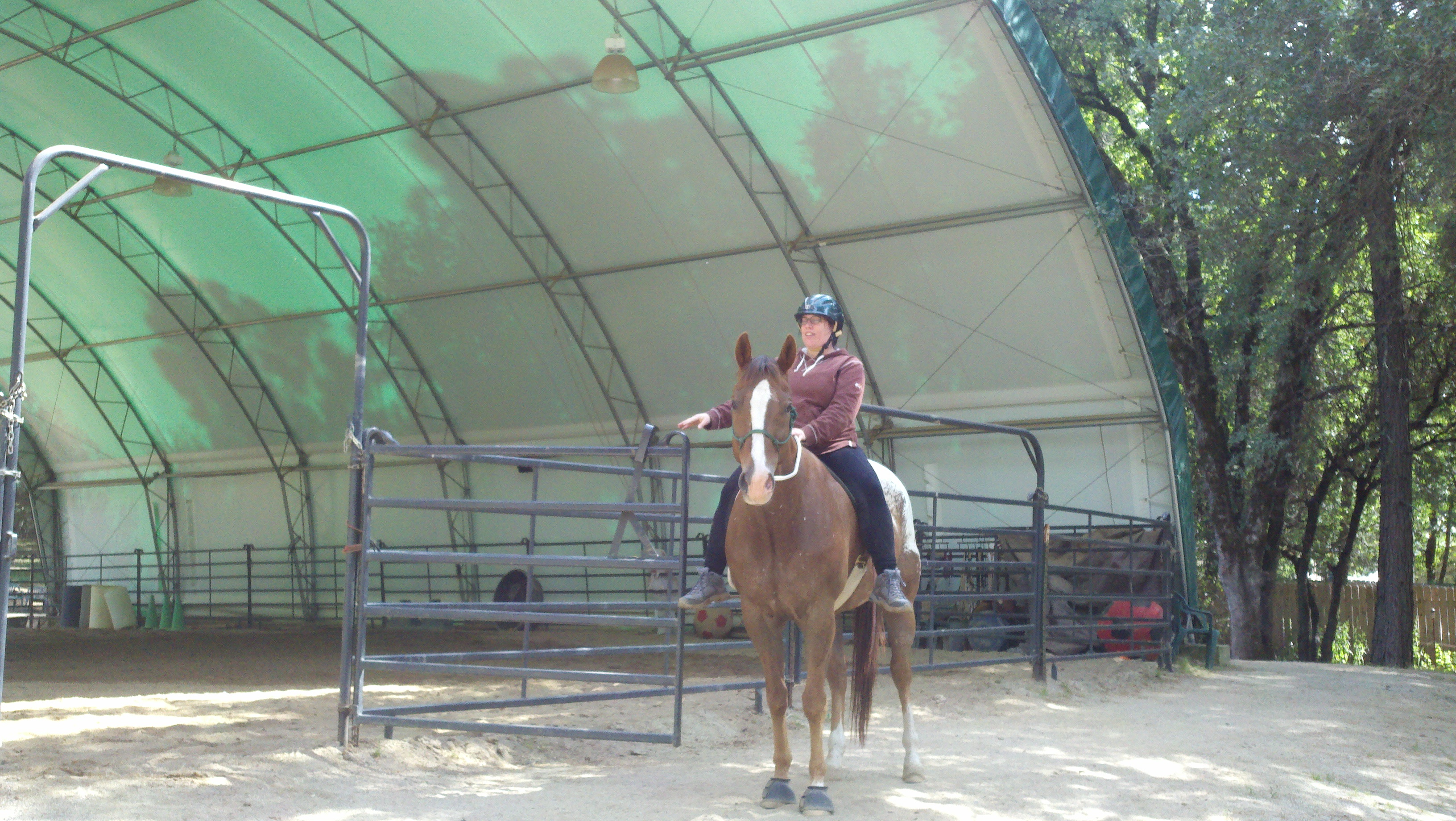
I took him to the covered arena and let him loose to roll and amuse himself while I went into the barn for my helmet, reins, and bareback pad. In the arena, I smoothed him off with my hand, and just for fun, set the bareback pad in place. He stayed with me and didn’t mind, so I cinched it, very slowly and gently. He still stayed with me. He got nippy at the cinching like he usually does, and I laughed and used my elbow and concentrated on not moving my feet.

I cinched it up enough that I thought it would stay in place and invited him to walk around with me, still at liberty, to see that he can move and be comfortable in it. I ended up tightening the cinch in teensy increments, three or four more times. At liberty. In different areas of the arena. By the time I went to clip the reins onto his halter, I’d forgotten he wasn’t wearing it, and we had to walk back to our staging area so I could put it on.

Freestyle Savvy

He stood still for mounting and didn’t even shake his head when I waited a while, breathing deeply to ground myself, and walked out nicely for follow the rail.

By the time I went to clip the reins onto his halter, I’d forgotten he wasn’t wearing it, and we had to walk back to our staging area so I could put it on.

I had put markers in all four corners this time to help me see where to keep us on the track and we did better. I also felt more fluidity at certain times and practiced trying to find that spot again with my body, because I could feel him walking out more, and being more even. I found it a few times. Rocky isn’t the only one who needs time and repetition to reshape his body habits!

We left the arena to walk on the ranch trail and used the arena gate as an Obstacle. It took a while but we each figured out each other’s needs, over time, and got the gate closed again.

On the trail, we stopped to talk to various people, practicing standing politely and with relaxation. Sometimes I swung my legs back and forth or lifted my arms out to my sides or patted him everywhere I could reach. This helps me not get locked into a rigid position, and gives Rocky something safe to think about. We even stopped by my office window twice to say hi to Steve via webcam. Steve caught some screenshots.

When it was all done, I had Rocky step close to a tack trunk for me to dismount easily, and then I stripped off everything and let him graze at liberty for 20 minutes. (Stripped of everything he was wearing, that is. I stayed fully dressed.)

When I returned him to his pen for dinner, he stayed with me, even though the other three horses were eating ostentatiously. I pointed to a hay feeder and said “good boy, go eat,” and patted his butt, and then he did go to his dinner while I floated into the house.

Categories: Freestyle, Liberty, On-Line | Tags: , , | Leave a comment

Blog at WordPress.com.