Feel

A mutual promise of rhythm, relaxation, and respect

Pat’s “problem horse makeover” segment of last month’s Savvy Club – Inside Access video shows Pat helping a woman who is just starting out with Parelli and a horse who “won’t let anyone touch his ears.” Here’s an excerpt:

Naturally, it’s not about the ears. It’s about the … say it with me … relationship. Pat explains that horses tend to get ear-shy because people take off the bridle too fast, allowing the bit to drop suddenly and clonk into the teeth. Ouch! The horse first starts bracing and then escalates to tossing his head and lifting it high and barging into the person’s space to dominate or trying to flee or otherwise resisting, because he knows that if he lets the person reach for his ears, he’s going to get punched in the mouth.

Pat sits down to work with the horse, to show us that we don’t have to be as tall, strong, or athletic as Pat to be effective. He uses a combination of Porcupine Game™ and Friendly Game™ to help the horse learn a new pattern of cooperative participation: relax, lower your head, and bridle or unbridle yourself.

Porcupine Game™ 

This is how you teach a horse to follow a feel and move away from pressure applied with your fingertips or the Carrot Stick. This game prepares him to understand how to respond to communicative feel (or pressure) from the rein, the bit, the leg, etc.

This pressure is applied with a steady feel (not intermittent poking) and steadily increasing intensity until the horse responds, at which time the pressure is instantly released. It is applied in Four Phases, each phase getting progressively stronger. Releasing only when the horse responds. In this way, it’s the release that teaches the horse he made the right move. Reward the slightest try with instant release, rubbing (as in the Friendly Game), and a smile. ~ The Seven Games, Parelli.com

Pat also shows the horse that humans can be more cooperative and relaxed, and without directly saying so on camera, expects that the owner will henceforth ensure that anyone who handles this horse (and hopefully any others she is responsible for) does so with the attitude and techniques that Pat demonstrated.

Rockstar was head-shy when I got him and would fling his head up and become 27 feet tall if I reached toward his poll. If I stood on a mounting block to reach, he would pin the ears and lean away from me. If that didn’t work, swing into me. Luckily for us both, I found Parelli soon after buying him, and I had a good horsewoman friend and instructor in Jenni (of Ravendaisy Farms in the Los Angeles area, shameless plug!).

As I watched the video of how Pat moved his hands and body and how the owner moved her hands and body, I understood why I’ve been able to get Rocky so much better about us touching his ears, but only to about 75 percent about 75 percent of the time. I’ve learned to be slower and more deliberate in my movements when I’m paying attention, but so often I’m still operating my body on auto-pilot while my half my mind is in the present moment and the other half is working on a dozen other things.

So yesterday I sat on the mounting block with Rocky in his halter and lead, brought my full attention into my body, and allowed the moment to permeate my skin. Then I played the combination of Porcupine Game™ and Friendly Game™ with “passive persistence in the proper position” until both Rocky and I won.
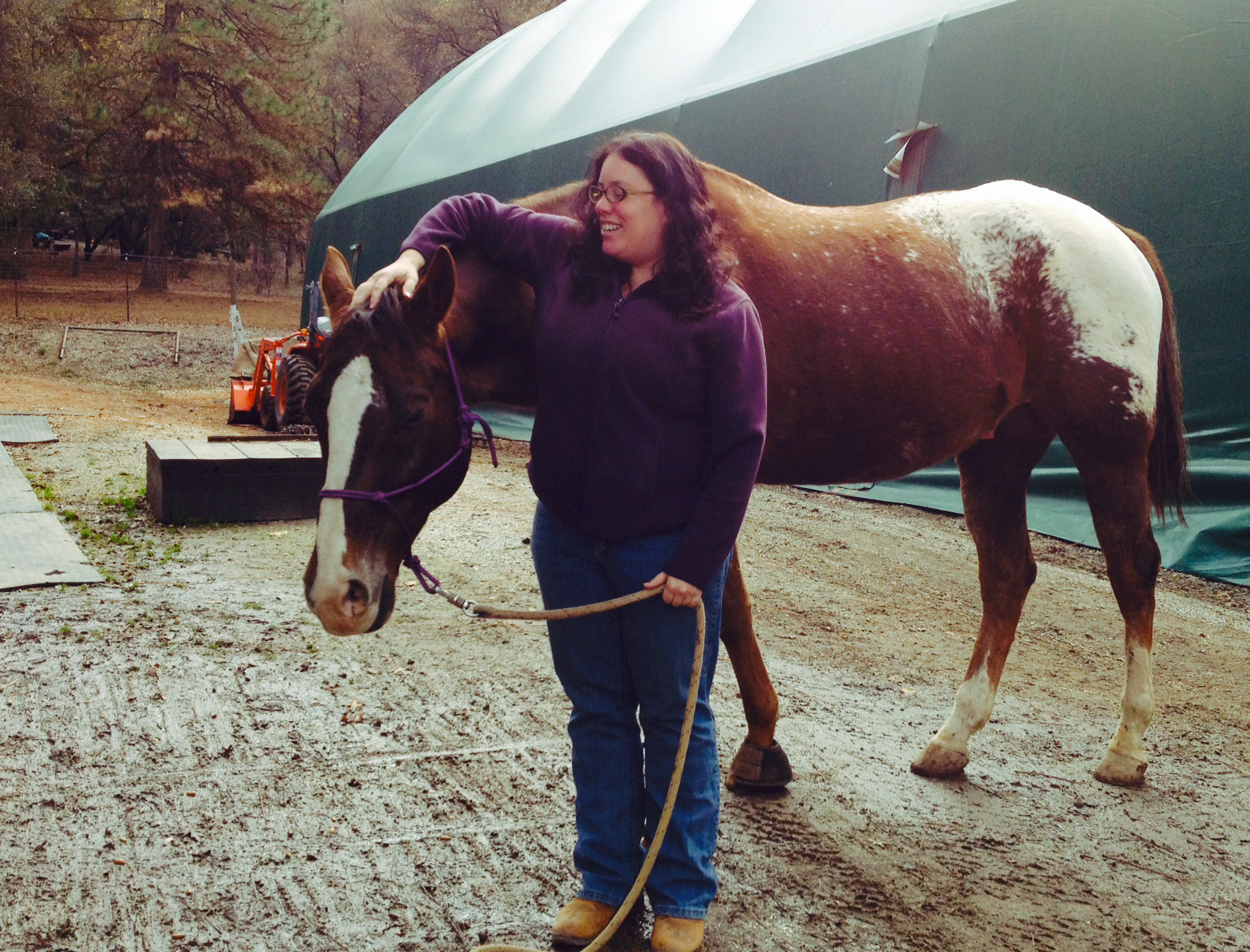
Resting my hand on Rocky's relaxed poll

I won, because Rocky relaxed and put his head down and blew out and licked and chewed and didn’t brace when I moved my hand toward his ears or when I asked him to lower his head an hour later. He even nudged me (gently) and leaned into the massage and sighed. To quote Linda Parelli, “that’s HUuuuuGE!”

Rocky won because he found relaxation and comfort in a position that has caused him anxiety for most of his life, and possibly pain for the first several years.

My goal for December is to improve my ability to uphold Responsibility #4: Use the natural power of focus. Three behavior changes that will help me meet this goal:

  • Save the talking for rest breaks. Talking with my ranch friends when I’m also asking my horse to do something, even something “easy” like “walk in a straight line along the rail,” splits my attention so much that I can’t use my focus effectively at my current level of skill.
  • Wear my glasses.
  • Only ask my horse to do things that I have an IMAX High Frame Rate mental picture of what it should look like. If I can’t picture it that vividly, find a video or ask Erin to demonstrate before I make the attempt.

I’m heading outside now for our last Freestyle practice session before filming our dress rehearsal audition on Saturday. The one area I’m still struggling with is riding with one carrot stick — so maybe I’ll just have to do it with two!

Categories: Feel | Tags: , | 2 Comments

Detailed horsemanship: building a better send

Erin interrupted herself in my lesson today, apologizing half-seriously. “I’m picking apart your send. I’m so picky! Picky picky picky!” I laughed and told her that’s what we hire her for, that I appreciate her attention to detail. “I’m picky with you because I know you can take it,” Erin said then.

Take it? I crave it. Erin excels at separating each step of a process, isolating and fixing the techniques that are causing problems, and recombining the steps into a process that works.

Lesson Flower

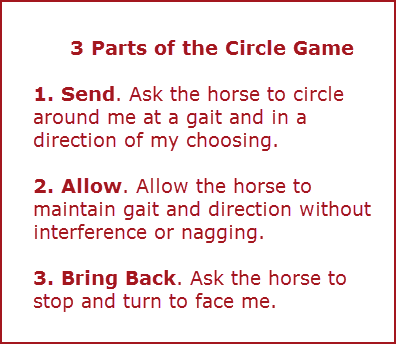
Today, the circle game at liberty proved powerful. River became not so much a mirror as a microscope. The cause of the problems was my send, and the solution was threefold.

1. Refine my phases

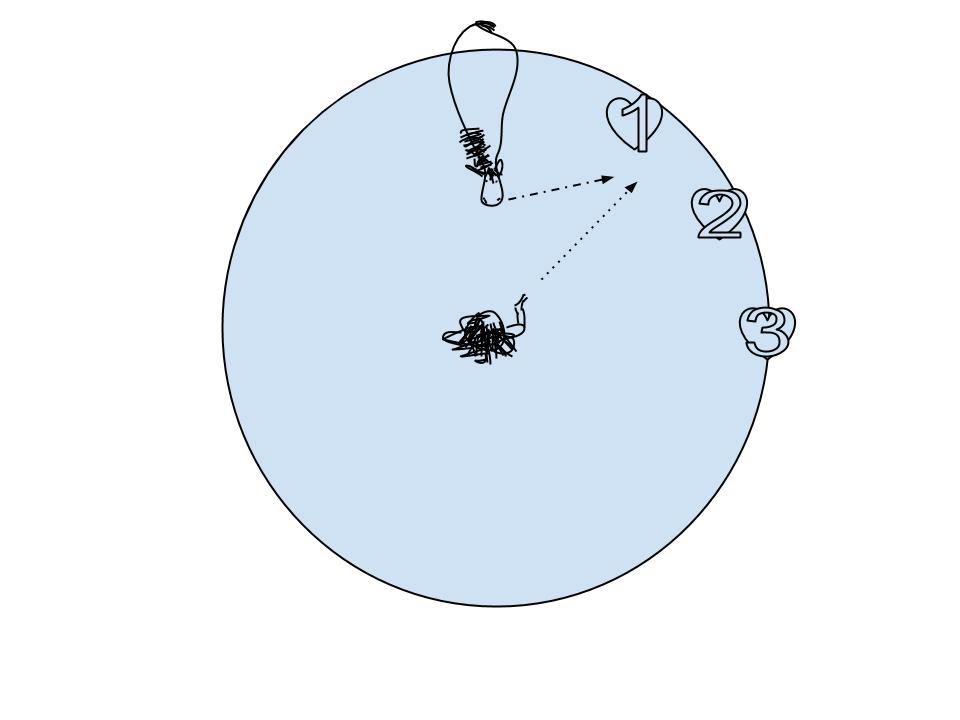
3 parts of the circle gameIn Parelli level 2, we learn to give the horse a long phase one and then if necessary a quick two-three-FOUR. We also learn about tagging the ground, not the horse, so that the horse has time to move forward and “win” the game by not getting tagged.

What I have ingrained in my body motion is to go up two-threeFOUR! with FOUR! being a loud, strong whzzzzzzWHAPP on the circle at 12 o’clock. Typically, River moves off of 12 o’clock just in time, slowly but impudently, and swishes her tail to show her disdain.

What Erin sees happening is that I am dulling River to the whzzzzzzWHAPP. And that it looks like I am threatening her, when I raise the stick and string and focus so intently on the spot and then “attack” it so hard. At the same time, I leave myself nowhere to go if I need to escalate, and I have convinced River that I’m usually not going to touch her so she doesn’t really have to get a move on.

Erin helped me refine my phases to be effective without threatening.

  1. Point.
  2. Add voice cue.
  3. Lift stick.
  4. Wiggle stick.
  5. Flick horse with string. A flick with intensity, but not a big loud fast overhead whzzzzzzWHAPP.

She also showed me that River is doing exactly what I’m asking her to do when I send. I have been rotating my body to “open” the circle, stepping back with one foot, and extending my arm to point to 5 or 6 o’clock. It is as if I am standing in a doorway and opening the door outward, inviting my guest to squeeze past me into the room — and then snapping at them for brushing too close to my body.

I am now practicing pointing to the spot on the circle where I want River’s nose to be when she turns and starts forward, somewhere around 1 or 2 o’clock.

circle game send

As I try this at my desk, I realize this is the same as the direct rein position in level 2 freestyle riding. Hmm, how interesting!

2. Release at the appropriate time

During our warm-up, River had trouble maintaining direction at liberty at the canter when going to the left. At about 10 o’clock on the circle, she would spin with her nose away from me (sigh) and squirt back the other direction. I tried a few techniques, such as flicking some energy toward her zone 4 when she was 180 degrees from her sticking spot (at 5 o’clock on the circle) or the “OH, you want to go right? okay, go right FASTER” game. I also tried moving in front of her to block her after her U-turn and drive her back in the correct direction. This strategy worked best, but I still wasn’t getting full circles.

Erin helped me discover that I was giving small, intermittent releases when turning River around. I’d release when River slowed, pressure her to turn and then release when she was facing away, pressure to drive her forward and release as soon as she took a step. With Erin’s guidance, I brought my energy up and kept the pressure on until River had slowed, pivoted, launched into the canter, and taken a couple of strides.

This allowed River to find a true release in upholding her responsibility to maintain gait and direction. It also communicated my directions more clearly than a series of RED LIGHT green light RED LIGHT green light. As she learns that she can trust the true release, she will seek it, and not expend so much extra energy in changing directions.

3. Delegate responsibility

Standing calmly when asked is another form of maintaining gait and direction. That means that when I back her out during yo-yo game, she can wait until she gets the next signal, which could be to come back in, or it could be to circle, or it could be to sidepass — it could be anything. It also means she can stand still for having her feet cleaned, without stepping forward to nuzzle my helmet or slobber on the saddle. The “send” in this context is my asking her “halt here” and is no different ffom asking her to “canter left” or “trot right.”

It’s about refining my control of my intention, energy, and relaxation so that River can become calm, connected, and responsive, no matter what we are doing.

Categories: Feel, Liberty, River | Tags: , , | 3 Comments

Blog at WordPress.com.